Key Takeaways
- Autism masking involves consciously or unconsciously changing natural behaviours or communication styles to meet social expectations.
- Common signs include rehearsing conversations, copying social behaviours, suppressing stimming and feeling mentally or physically exhausted after social interactions.
- Although masking may help someone navigate everyday life, prolonged masking is linked to autistic burnout, anxiety, delayed diagnosis and difficulties with identity.
- Masking can affect autistic children and adults of any gender, and many people do not realise they have been masking until later in life.
- Recognising autism masking is an important step towards understanding your experiences and accessing neurodiversity-affirming support when needed.
You’re driving home after meeting friends. The conversation went well. You smiled, laughed at the right moments and nobody seemed to notice anything unusual.
But the moment you’re alone, you’re completely drained. You’re replaying every conversation in your head, wondering whether you made enough eye contact, talked too much, interrupted someone, or said the wrong thing. You need hours – or sometimes days – to recover from what everyone else calls a “normal” social interaction.
If this experience feels familiar, understanding the common signs of autism masking is the next step. In this article, you’ll discover the key signs of autism masking, why they often go unnoticed, and what they may mean for your wellbeing.
Defining Autism Masking
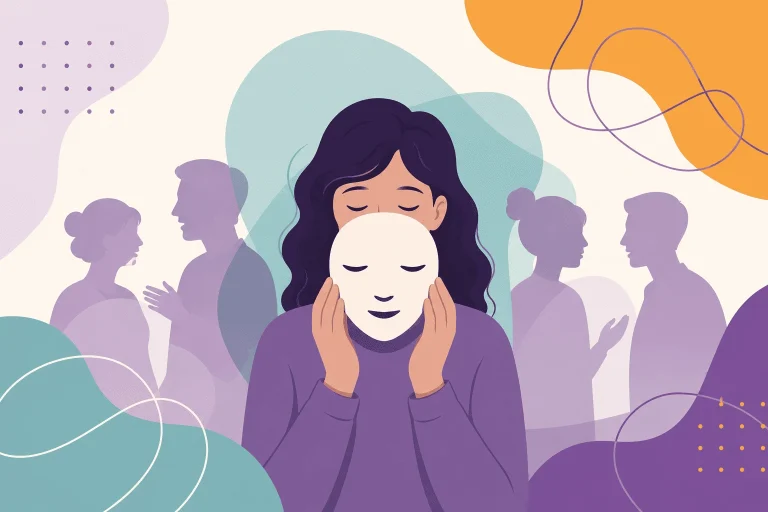
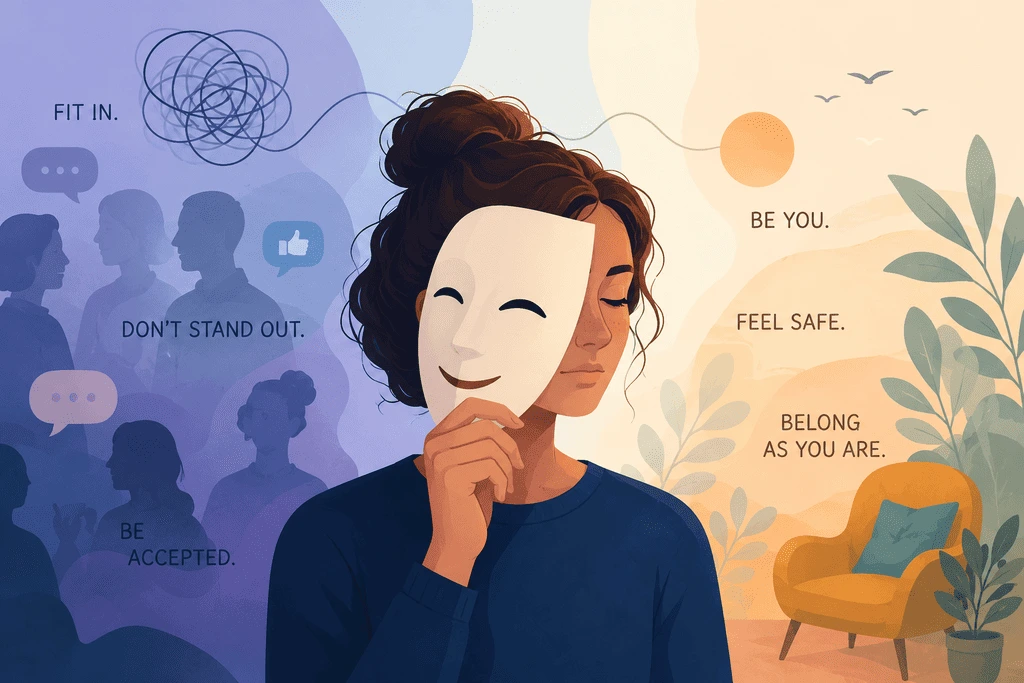
Autism masking is the continuous adjustment of how an autistic person communicates, reacts or expresses themselves in order to move more easily through a world built around neurotypical social expectations.
Dr. Lorna Wing was among the first researchers to observe that some autistic people, particularly women, hid their autistic traits to cope with social life. This experience was later echoed by autistic authors such as Gunilla Gerland and Liane Holliday Willey, who wrote about the pressure to appear “normal” in everyday situations. (Pretending to Be Normal and A Real Person: Life on the Outside are the two landmark autobiographical works that are most commonly cited when discussing the early recognition of autism masking.)
Autism masking is often described as hiding autistic traits, but that definition is only of the story. In reality, masking is the continuous mental effort of checking, adjusting and second-guessing yourself in situations where other people can simply be themselves.
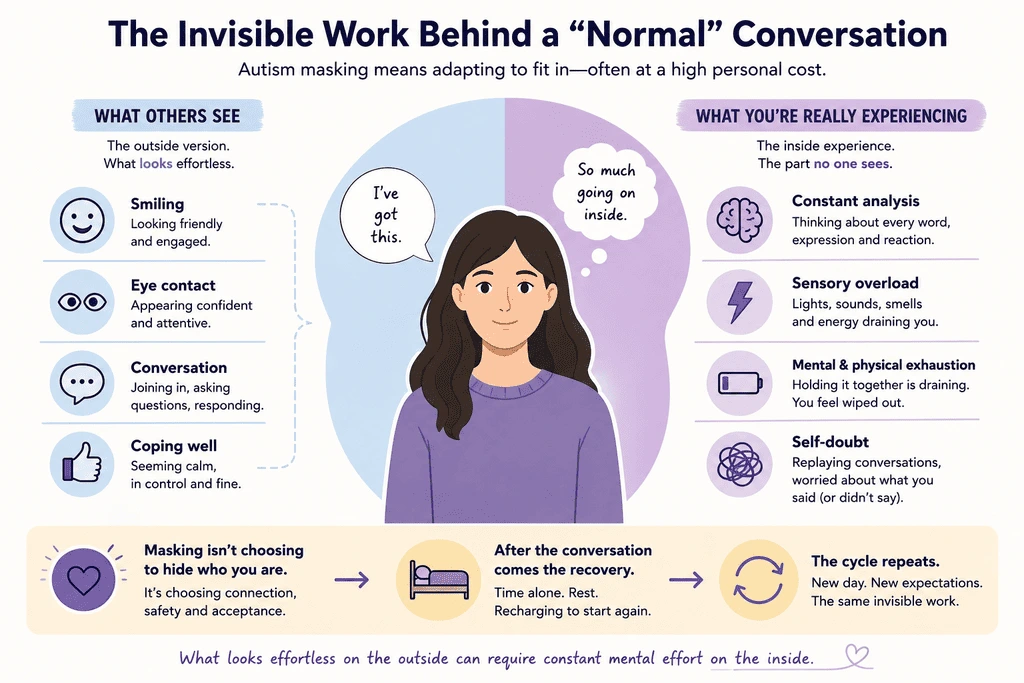
Instead of responding naturally, a person may spend every interaction making hundreds of small decisions – whether to make eye contact, when to speak, how much emotion to show, whether a sensory reaction is noticeable, or whether a natural behaviour should be suppressed.
Some autistic children begin developing masking strategies during primary school, long before they have the language to explain why they feel different. What starts as copying classmates or suppressing natural behaviours can gradually become an automatic way of surviving social life.
Masking doesn’t only affect friendships or work. Studies suggest it can also influence clinical assessments, meaning autistic people may appear to cope well during short appointments while struggling significantly in everyday life. This is one reason some people experience delayed or missed autism diagnoses.
Dr. Laura Hull, one of the leading researchers on autistic camouflaging, has described masking as something that can become “habitual”, meaning people may continue doing it without consciously realising it. This explains why many late-diagnosed autistic adults say they only recognised their masking behaviours after learning about autism.
Over time, this constant self-monitoring can become so habitual that many people don’t realise they’re masking until years later, often after receiving an autism diagnosis.
Although masking may reduce social challenges in the moment, the cumulative impact can affect mental health, identity and overall wellbeing.
Recognising these patterns can help you understand whether you’re adapting to situations – or constantly hiding parts of yourself to get through them.
Why Do People Mask Autism?
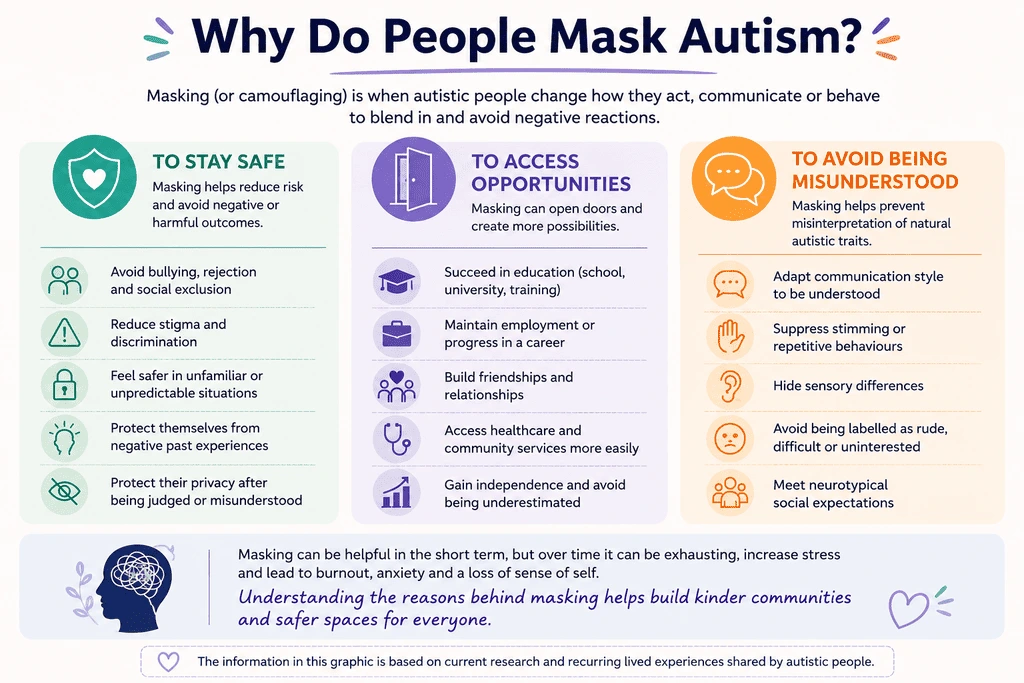
People mask autism for three broad reasons: to stay safe, to access opportunities, and to avoid being misunderstood.
It often develops through everyday experiences – being laughed at for speaking too directly, corrected for not making eye contact, told to stop fidgeting, excluded from friendships, or feeling that social rules seem to come naturally to everyone except them. After experiencing these situations repeatedly, many begin changing how they communicate, move or respond, hoping to avoid the same reactions in the future. What starts as a way of coping in certain situations can gradually become an automatic way of navigating everyday life.
Some of the most common reasons of autism masking include:
- To stay safe
- Avoid bullying, rejection and social exclusion
- Reduce stigma and discrimination
- Feel safer in unfamiliar or unpredictable situations
- Protect themselves from negative past experiences
- To access opportunities
- Succeed in education
- Maintain employment or progress in a career
- Build friendships and relationships
- Access healthcare and community services without unnecessary barriers
- Gain independence and avoid being underestimate
- To avoid being misunderstood
- Adapt communication style
- Suppress stimming or repetitive behaviours
- Hide sensory differences
- Avoid being labelled as rude, difficult or uninterested
- Meet neurotypical social expectations
What People Say
When autistic people are asked why they started masking, their answers are remarkably similar. Many describe years of being told they were “too much”, “too quiet”, “too blunt” or simply “different”. Others remember copying classmates, rehearsing conversations or hiding behaviours that attracted unwanted attention. Over time, these repeated experiences taught them that changing how they acted often led to fewer negative reactions.
The Double Empathy Problem, first proposed by Dr Damian Milton, suggests that communication differences between autistic and non-autistic people are mutual rather than one-sided. Instead of viewing autistic people as lacking social skills, the theory explains that both groups may struggle to understand each other’s perspectives and communication styles. This helps explain the close relationship between autism masking and the Double Empathy Problem, as many autistic people learn to hide or adapt their natural behaviours to reduce misunderstanding, meet neurotypical expectations and navigate everyday social situations.
The statements below are paraphrased from lived experiences shared by autistic people in public forums, books and community discussions.
- “I realised people reacted differently when I acted naturally.”
Many autistic people describe noticing that they were treated differently whenever they communicated, moved or expressed themselves naturally. Over time, they began changing those behaviours to avoid the same reactions. - “I kept being told I was rude, even when I wasn’t trying to be.”
Many people recall being labelled as rude, cold or uninterested because of differences in communication, facial expressions or tone of voice. Eventually, they started adjusting how they spoke and interacted to avoid being misunderstood. - “I copied everyone else.”
A common experience is learning social interaction by observation—copying facial expressions, gestures, humour, eye contact or conversation styles because these behaviours did not come naturally. - “I just wanted people to stop treating me differently.”
Many autistic people explain that masking was never about becoming someone else. It was about reducing bullying, judgement, exclusion or unwanted attention in everyday life. - “Eventually, I couldn’t tell where the mask ended and I began.”
After years of masking, some people describe losing touch with their authentic identity, finding it difficult to distinguish between behaviours they had learned for acceptance and those that genuinely reflected who they were.
Who is Most Likely to Mask Autism?
There is no single profile of a person who masks autism. However, clinical research and the experiences of autistic people consistently show that masking is more common in people whose autistic characteristics are subtle, misunderstood or repeatedly overlooked by the people around them.
- Autistic women and girls – Autism is frequently diagnosed later in life in women, with many receiving a diagnosis during their 20s or beyond. They are more likely to imitate peers, rehearse conversations, suppress repetitive behaviours and develop socially acceptable coping strategies. As a result, many remain undiagnosed until adolescence or adulthood despite experiencing significant daily challenges.
- Late-diagnosed autistic adults – Many spend years believing they are simply “too sensitive,” socially awkward or anxious. Without understanding the reason behind their differences, they often refine masking strategies throughout adulthood before finally receiving an autism diagnosis.
- People with less obvious autistic characteristics – Individuals with strong verbal communication, average or high intelligence, or the ability to maintain employment or relationships may appear to cope well externally. However, these outward skills can hide the amount of mental effort required to navigate everyday life.
- People with co-occurring mental health difficulties – Anxiety, depression, eating disorders, obsessive-compulsive disorder (OCD) and trauma frequently coexist with autism. In many cases, these conditions develop alongside years of masking, while in others they further encourage someone to conceal autistic behaviours, making autism more difficult to recognise.
- People with other developmental disorders – Those with ADHD, learning disabilities or language and communication differences may have autistic traits overlooked because professionals or families attribute their difficulties to another diagnosis. This phenomenon, known as diagnostic overshadowing, can contribute to years of unnoticed masking.
- People from environments where differences feel unsafe – People who have through bullying, discrimination, family pressure, workplace expectations or cultural stigma are often more likely to hide autistic characteristics in order to avoid rejection, conflict or unwanted attention.
Although these groups are more likely to experience masking, the strongest predictor is not age, gender or diagnosis – it is the environment. The greater the pressure to appear “normal” or fit social expectations, the more likely an autistic person is to develop masking behaviours, often at the expense of their wellbeing, identity and long-term mental health.
Can Children Mask Autism?
Yes. Children can begin autistic masking from a surprisingly young age, although it often looks different from masking in adults. Rather than consciously hiding who they are, many children gradually learn to copy classmates, suppress natural behaviours, force eye contact, stay unusually quiet, or avoid activities that draw attention to their differences.
These strategies often develop in response to repeated correction, bullying, social rejection or the desire to fit in at school. Because a child may appear to be coping during the day, the emotional cost of masking is frequently missed until they experience overwhelm, meltdowns, shutdowns or exhaustion once they return to the safety of home.
Signs You Are Masking Autism
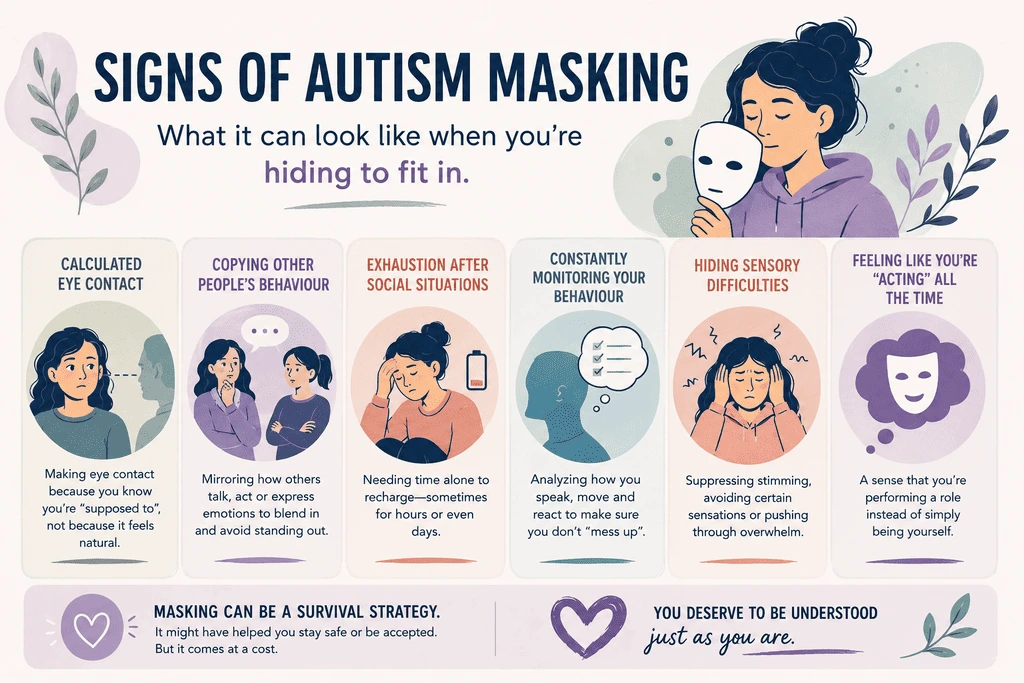
Autism masking is often described through behaviours, but its earliest warning signs are usually changes in a person’s energy, stress levels and sense of identity. Research suggests that the brain can devote substantial cognitive resources to continuously monitoring social behaviour, interpreting other people’s reactions and adjusting responses in real time.
The result is that the cost of masking is not visible during the interaction itself – it is more likely to appear afterwards as exhaustion, difficulty switching off, increased anxiety or the feeling that everyday life requires far more effort than it seems to for everyone else.
Calculated Eye Contact
Eye contact is often treated as a sign of confidence or attention, but for many autistic people it competes with the brain’s ability to process conversation. Looking directly at someone’s face can increase the amount of social and sensory information that has to be interpreted at once, making it harder to listen, think or formulate a response. As a result, some autistic people learn to treat eye contact as a task to be managed – counting seconds, glancing away at planned intervals or forcing themselves to “look interested” despite the discomfort. These strategies may make interactions appear more typical to others, but they also increase the cognitive effort required to communicate and are recognised as a common feature of autism masking.
Copying Other People’s Behaviour
Instead of relying on instinctive social responses, some autistic people may build a “social library” by observing how other people smile, laugh, use gestures, change their tone of voice or react in different situations, then consciously reproducing those behaviours when similar situations arise. While this can make interactions appear effortless, it often requires continuous observation, memory and self-monitoring. Over time, mimicking facial expressions, gestures or speech patterns can become such an automatic survival strategy that a person may struggle to distinguish which behaviours feel genuinely natural and which have been learned through autism masking.
Feeling Exhausted After Social Situations
Feeling unusually drained after spending time with other people is one of the most common signs you are masking autism. The exhaustion often comes from continuously monitoring your behaviour, managing sensory input and trying to meet social expectations. For many autistic people, recovery takes far longer than others might expect.
- Feeling as though their brain has “shut down” after socialising and being unable to think clearly.
- Needing to lie in a dark, quiet room because light, noise or conversation suddenly feels unbearable.
- Losing the ability to speak or finding it difficult to find words after a busy day.
- Feeling physically heavy, as if every movement requires extra effort.
- Sleeping for several hours after a social event or cancelling plans for the following day to recover.
- Becoming unusually irritable or emotionally overwhelmed by small demands once they get home.
- Experiencing headaches, muscle tension or a feeling of being “wired but exhausted.”
- Feeling detached from themselves, as though they have been “playing a role” for so long that they need time to reconnect with who they are.
- Avoiding messages, phone calls or further interaction because they have completely run out of social energy.
- Feeling relief the moment they are finally alone and no longer have to monitor their facial expressions, tone of voice or body language.
Constantly Monitoring Your Behaviour
For many autistic people, social interactions involve an ongoing internal commentary that other people rarely notice. Instead of focusing only on the conversation, part of their attention is continuously checking whether they are following unspoken social rules. Thoughts such as “Am I making enough eye contact?”, “Did I interrupt?”, “Am I talking too much?” or “Was that facial expression appropriate?” can run in the background throughout an interaction. This constant self-monitoring helps reduce the risk of being misunderstood or judged, but it also demands significant mental energy. Over time, this habit can become so automatic that it continues even after the conversation has ended, with many people replaying interactions to analyse whether they “got it right.”
Hiding Sensory Difficulties
Many autistic people learn to hide their sensory needs because the behaviours that help them cope are often misunderstood. They may suppress stimming – such as fidgeting, rocking, hand movements or using objects for sensory regulation – or force themselves to stay in noisy, bright or crowded environments despite feeling overwhelmed. Some also ignore early signs of sensory overload to avoid drawing attention to themselves.
While these strategies may help someone appear comfortable on the outside, they often come at the cost of rising stress, fatigue and, eventually, sensory overwhelm. Feeling unable to respond naturally to sensory discomfort is one of the most common signs you are masking autism.
The Difference Between Autism Masking and Social Anxiety
Autism masking and social anxiety can look similar on the surface, but they are driven by different underlying processes. Understanding why a person behaves in a certain way is often more important than the behaviour itself.
| Autism Masking | Social Anxiety |
|---|---|
| Driven by adapting to social norms and hiding autistic traits. | Driven by fear of being judged, criticised or embarrassed. |
| Often involves suppressing stimming, copying social behaviours and carefully monitoring communication. | Often develops after negative experiences, bullying, trauma, repeated criticism or reduced self-confidence. |
| The goal is to avoid standing out or being misunderstood. | The goal is to avoid rejection, humiliation or social failure. |
| Can happen even when the person enjoys spending time with others. | People often want social connection but fear the outcome of social situations. |
| Usually leaves the person mentally and physically exhausted because of the constant effort involved. | Anxiety symptoms may include racing thoughts, panic, shaking, sweating or avoiding social situations altogether. |
Can They Exist Together?
Yes. In fact, many autistic people experience both. Years of masking, repeated misunderstandings and negative social experiences can gradually reduce confidence and increase anxiety, making social situations feel even more demanding. This creates a cycle where anxiety encourages more masking, while masking itself becomes increasingly exhausting.
The Heavy Cost: Autistic Burnout and Fatigue
Months or years of suppressing autistic traits can leave the nervous system in a prolonged state of stress. For many autistic people, the result is autistic burnout – a severe loss of physical, emotional and cognitive energy that cannot be resolved by simply resting over the weekend.
Research has linked prolonged masking with higher rates of mental health challenges, including:
- Anxiety
- Depression
- Chronic fatigue
- Sleep problems
- Self-harming thoughts
During autistic burnout, people may temporarily lose skills they previously relied on, struggle to communicate, become unable to work or study, withdraw from relationships or experience frequent meltdowns and shutdowns. In some cases, burnout can escalate into a mental health crisis, leading to emergency support or hospital admission if the underlying autistic needs remain unrecognised. Early identification, an appropriate autism assessment and personalised strategies that genuinely support autistic people are essential to reduce the need for masking and prevent these long-term consequences.
How to Begin Unmasking Safely
Many autistic people spend years adapting to other people’s expectations before they begin questioning whether those adaptations are still serving them. Unmasking autism is the process of slowly replacing survival habits with choices that support your wellbeing, while keeping the coping mechanisms that genuinely help you feel safe.
Start Reducing Masking Safely
Many autistic people have spent years perfecting ways to fit in, so expecting those habits to disappear overnight is neither realistic nor helpful. Practising self-acceptance means recognising that your natural communication style, sensory needs and ways of regulating emotions do not need to be hidden to deserve respect. The first step is not changing who you are-it is becoming curious about which behaviours reflect you and which exist only to meet other people’s expectations.
Create a Safe Zone
Everyone needs at least one place where they can stop performing. That might be your home, a trusted friend’s house or simply time spent with someone who accepts you without expecting constant eye contact, rehearsed conversations or perfectly timed social responses. Having a space where you can communicate naturally, take sensory breaks and simply exist without judgement gives your nervous system the opportunity to recover instead of staying in a constant state of alert.
Reconnect with Stims
Many autistic adults realise they stopped stimming because they were taught it looked “strange” or “inappropriate.” Yet stimming is one of the body’s natural ways of regulating stress and sensory input. Reconnecting with movements that feel calming – whether that’s using a fidget tool, pacing, rocking, stretching or tapping your fingers – can help reduce tension and support emotional regulation. The goal is not to stim more, but to stop denying your body strategies that genuinely help it feel safe.
Establish Boundaries
Learning to say no is often an important part of unmasking. You do not have to accept every invitation, stay until the end of every event or push through exhaustion to avoid disappointing other people. Setting boundaries around social plans, allowing yourself to leave early or choosing quieter environments are not signs of failure – they are practical ways to protect your energy and reduce the pressure that makes masking feel necessary.
Noticing Masking Can be a Helpful First Step
The goal is not to ask, “How do I stop masking?” The better question is, “What made me feel I had to start?” For many autistic people, social camouflaging began as a survival strategy, not because anything was wrong with them, but because it helped them navigate environments where their natural way of communicating or responding was misunderstood. Developing self-awareness allows those patterns to become visible, making it easier to decide which adaptations still serve you and which are simply exhausting. A neurodiversity-affirming therapist can support this process by helping you understand your needs and build a life that requires less masking, not more.
Autism Support with Catalyst Care Group
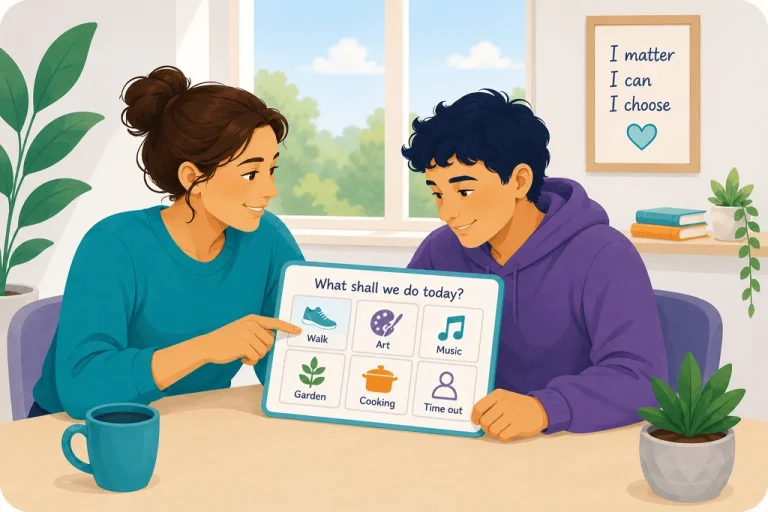
At Catalyst Care Group, we have seen how years of masking can lead to mental and physical exhaustion, anxiety, burnout and loss of confidence. That is why our multidisciplinary team-including Positive Behaviour Support (PBS) practitioners, Community Psychiatric Nurses (CPNs) and Community Transition specialists-takes the time to understand each person’s social communication, sensory needs, strengths and aspirations. Instead of expecting people to adapt to our service, we adapt our support to the person.
Using evidence-based, trauma-informed and person-centred approaches, we support people with autism and developmental differences to feel understood, respected and in control of their lives. Whether someone is transitioning from hospital, recovering after a mental health crisis or receiving long-term community support, our focus is on reducing distress, building confidence and creating environments where they no longer feel they have to hide who they are.
If you or someone you care about would benefit from personalised autism support, contact us today to find out how we can help.
FAQ
Can you mask autism without knowing it?
Yes. Many autistic people begin masking during childhood without consciously deciding to do so. Over time, behaviours such as copying others, suppressing stimming or carefully monitoring social interactions can become automatic. Some people only recognise they have been masking after receiving an autism diagnosis or learning more about autistic experiences.
Can autism masking delay a diagnosis?
Yes. Autism masking can make autistic traits less visible, particularly during clinical assessments. As a result, some people, especially those who have developed strong masking strategies, may not receive an autism diagnosis until adolescence or adulthood. This is one reason many autistic adults report years of feeling misunderstood before being correctly identified.
What happens when you stop masking autism?
Stopping autism masking, often called unmasking, can help people feel more authentic, reduce stress and improve mental wellbeing. However, unmasking is usually a gradual process rather than an immediate change. Many people feel more comfortable expressing their natural communication style, sensory needs and self-regulating behaviours when they are in supportive and accepting environments.
Why is autism masking more common in females?
Yes. Autism masking appears to be more common in autistic females, although it can affect people of all genders. Many girls learn from an early age to copy social behaviours, hide behaviours that might attract attention and work hard to fit in with their peers. Because these strategies can make autistic traits less noticeable, many women are diagnosed later in life than men.