“I am different, not less.”
-Temple Grandin
Empathy means understanding other people’s feelings. But we are all different, with unique perspectives, needs, and emotions. What might feel like an exciting film to one person may feel tense or even unwatchable to another. There is no single rule that determines whether something is right or wrong – it depends on how each person experiences it.
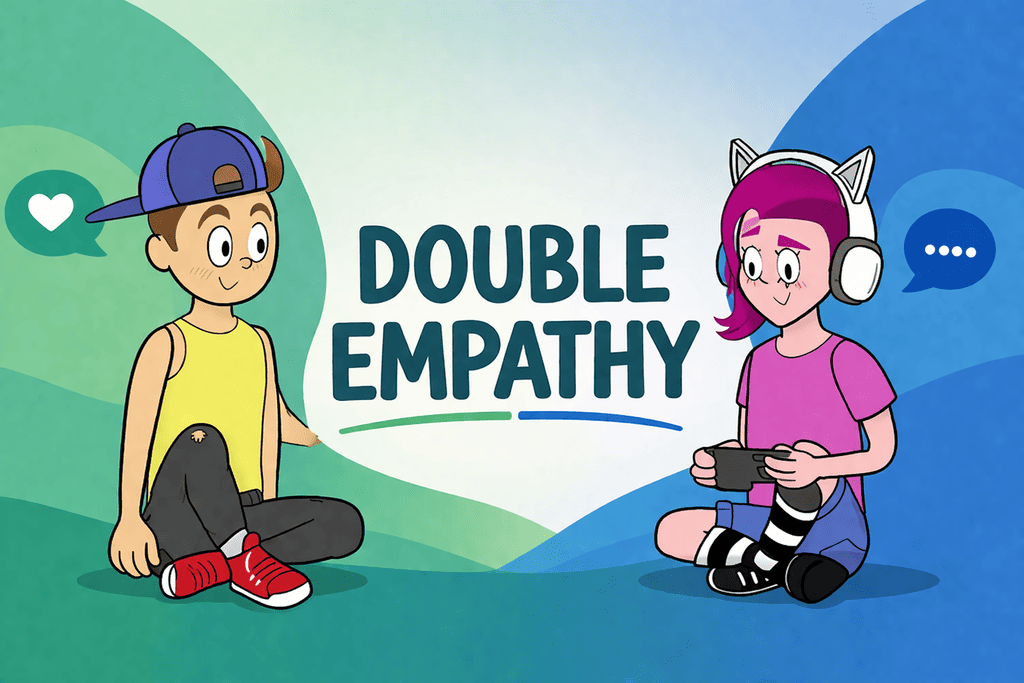
And that is what the double empathy concept is all about.
What Is the Double Empathy Problem?
The Double Empathy Problem describes what happens when people with different ways of experiencing the world try to understand each other – and both sides, including neurotypical peers, can find it difficult.
It challenges the idea that one person is simply “better” at empathy. Instead, it shows that cognitive empathy – the ability to understand another person’s thoughts and perspective- can be harder when experiences, communication styles, and ways of processing the world differ, especially during early development in young minds.
When people experience the world in different ways, it can make understanding each other harder for both sides.
So when an autistic person and a neurotypical person may struggle to connect, it doesn’t mean one is better at communicating. They’re simply approaching the interaction from different perspectives, with different ways of expressing and making sense of things.
It also means communication breakdowns aren’t something one person needs to fix. The difficulty lies in the space between people, not in one person alone.
For example, let’s think of what happens when two neurodivergent students interact.
Conversation often flows more naturally. They understand each other’s humour. There is an ease in the interaction, even if it looks different from typical communication styles. Their communication styles align, allowing for strong social understanding.
They are not struggling with communication – they are communicating effectively with people who share a similar way of interacting.
Now consider an autistic student who appears withdrawn during group discussions but engages deeply in one-to-one conversations.
Or a student who finds classroom chatter overwhelming but communicates meaningfully with a teaching assistant.
These are not examples of communication failure. They show how different environments and communication partners bring out different strengths.
Once we understand the double empathy problem, we can begin to make thoughtful adjustments.
“We are not defective versions of normal. We are different versions of human.”
– John Elder Robison
Why Does This Topic Matter Today?
This topic matters today because misunderstanding is still part of everyday life for a lot of people.
You can be trying to communicate, trying to connect, and still feel like it’s not quite working. And when that happens, the assumption is often that one person is getting it wrong.
But that’s not how it feels when you’re in it.
Sometimes it’s just two people coming at the same moment from completely different perspectives – and missing each other. Not because anyone lacks empathy, but because understanding doesn’t always come naturally.
That’s what the double empathy idea brings into focus.
Right now, more people are speaking openly about their experiences and how often they’ve felt misunderstood, especially in spaces where they were expected to “fit” rather than be understood. It’s becoming clearer that the problem isn’t one-sided.
And that shift matters.
Because the way we understand each other influences everything – from everyday conversations to how support is given. When we stop assuming and start trying to meet each other halfway, things change in a very real way.
It becomes less about fixing people and more about actually understanding them.
The Origins of the Double Empathy Theory
Dr. Damian Milton first introduced this theory in 2012.
In the past, when communication difficulties arose between autistic and neurotypical people, they were often attributed to the autistic person being seen as lacking empathy or social understanding.
Research has shown that non-autistic people can form less favourable impressions of autistic people in just a few seconds – sometimes based on very limited information such as brief video clips or short interactions. These impressions often happen before any meaningful communication has even taken place.
There is also evidence that autistic people may show equal or even stronger empathy in certain contexts, particularly when emotional experiences are shared or clearly expressed. This challenges the long-standing idea that empathy itself is reduced.
But Milton concluded something important.
Neurotypical people find it just as difficult to understand autistic people as autistic people find it to understand them. It is a mutual communication gap, not a one-sided difficulty.
The Emotional Impact on Neurodivergent People
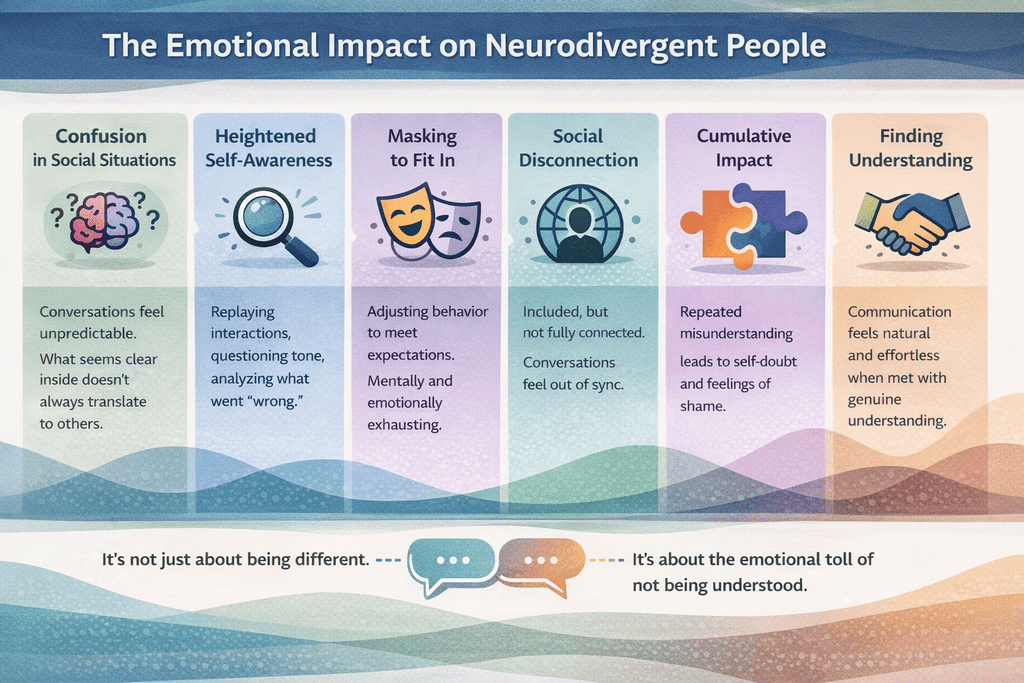
Many people describe growing up with a persistent sense of confusion in social situations. Not confusion about their own intentions, but about how those intentions are received.
Conversations can feel unpredictable. What seems clear internally does not always translate in a way others understand. This gap often leads to repeated moments of being corrected, misunderstood, or responded to in ways that feel disproportionate to what was meant.
Over time, this creates a heightened level of self-awareness. Neurodivergent people often speak about analysing interactions in detail – replaying conversations, questioning tone, and trying to identify where things may have “gone wrong.”
In many cases, this reflects a sustained effort to understand others and avoid further misunderstanding.
A widely reported experience is masking – adapting behaviour to align with social expectations. This can include adjusting eye contact, rehearsing conversations, copying social cues, or suppressing natural responses.
While masking can help navigate certain environments, people often describe it as mentally and emotionally exhausting. It requires continuous monitoring and can lead to a disconnect between how someone presents and how they actually feel.
Another theme that appears consistently in lived experience accounts is a sense of social disconnection, even in the presence of others.
People describe being included physically but not feeling fully part of interactions. There can be a slight delay in processing, difficulty entering conversations at the “right” moment, or a sense that communication is happening on different wavelengths. This can lead to feelings of isolation that are not always visible from the outside.
The emotional impact is rarely tied to a single event. Instead, it builds gradually through repetition.
Being misunderstood, excluded, or expected to adjust without mutual understanding can affect self-perception over time. Some people describe developing feelings of shame or a belief that they need to change core aspects of themselvesto be accepted.
At the same time, many neurodivergent people describe a contrasting experience when interacting with others who share similar communication styles or who make an effort to understand them.
In these situations, communication often feels more natural and less effortful. There is less need for monitoring or adjustment, and a stronger sense of being understood. These experiences highlight that the challenge is not located solely within the person, but within the interaction itself.
Overall, real-world accounts point to a shared emotional pattern: ongoing effort, frequent misunderstanding, and the impact of navigating environments that are not designed with neurodivergent communication in mind.
How the Double Empathy Gap Shows Up in Everyday Life
The double empathy problem can be seen every day in the playground, in the classroom, at work or at school. It can be present everywhere as we already live with a built stereotypic opinion overall. It is not just about neurodivergent people, but about people in general.
This is mostly due to limited knowledge and narrow perception. Autism research has shown that misunderstandings are often mutual, shaped by differences in communication styles rather than a lack of empathy. Research into mental health further highlights how repeated misunderstanding can affect confidence, increase anxiety, and lead to withdrawal over time.
The autistic experience reflects this clearly – many people describe feeling misread or judged, while also finding it difficult to interpret unclear expectations, indirect communication, or unspoken social rules.
Differences in Interpreting Social Norms
Miscommunication in conversations often comes from different communication challenges, where even emotional empathy is present but not always recognised or understood.
- Communication differences: Autistic people may speak more directly, while neurotypical peers often rely on hints or tone – so the same message can be understood in very different ways.
- Facial expressions: A calmer or less expressive face might be seen as disinterest or frustration, even when someone is fully engaged and processing.
- Eye contact: What looks like avoidance can actually help with focus, as eye contact may feel overwhelming or distracting.
- Small talk: Different expectations around conversation – depth vs. light social exchange – can make interactions feel tiring for both sides.
Challenges at School and Home Environment
Challenges at school and at home often reflect differences in how people understand, communicate, and respond to one another, including:
- Honesty misunderstood: In social interaction, an autistic child’s clear and concise way of communicating can be taken as being bossy, rude, or “too intense.”
- Unclear expectations: When instructions are vague, autistic children may feel anxious or unsure, which can be misinterpreted as defiance or low motivation.
- Social expectations vs. strengths: In later settings, people who mask their differences may still be seen as “too intense” or encouraged to socialise more – despite strong performance – because they don’t fit typical expectations around social interaction.
Emotional Misunderstandings
Emotional misunderstandings often come from a place of mutual misunderstanding, where both people care but interpret each other’s feelings in different ways.
- Showing care in different ways: Autistic people may express empathy by sharing similar experiences or offering solutions, which can sometimes be mistaken for being self-focused or emotionally distant.
- Unspoken expectations: Difficulties can arise when social “rules” aren’t clearly explained, leading to confusion or frustration over time.
- Sensory and routine differences: Loud environments or sudden changes in plans can feel overwhelming or disruptive, even if this isn’t immediately understood by others.
Real‑life Examples of the Double Empathy Problem
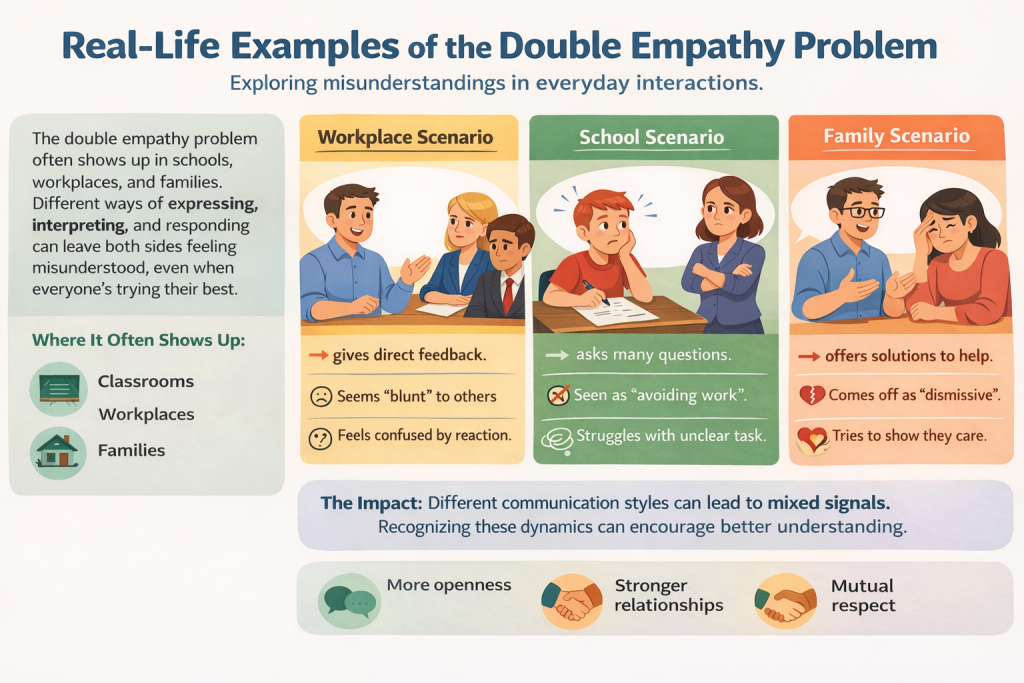
The double empathy problem often shows up in everyday places- classrooms, workplaces, healthcare settings, friendships, and family relationships. It tends to appear in moments where people are trying to connect or support each other, but leave the interaction feeling confused or misunderstood. What’s happening underneath is not a lack of empathy, but a mismatch in how people express, interpret, and respond to one another.
Workplace example:
An autistic team member gives direct, honest feedback during a meeting, focusing on what could be improved. Colleagues may experience this as blunt or uncomfortable, while the intention was to be clear and helpful. At the same time, the autistic person may not understand why the reaction feels tense, especially if no one explains it openly.
Family example:
A person becomes upset and shares something emotional. In response, an autistic family member offers practical solutions or shares a similar experience to help. This can be interpreted as dismissive or “making it about themselves,” while for them, it is a genuine way of showing care and trying to connect.
School example:
A student becomes anxious when given an assignment with unclear or open-ended instructions. Instead of starting the task, they hesitate or ask repeated questions to try to understand what’s expected. A teacher might interpret this as avoidance or lack of motivation. At the same time, the student is trying to manage uncertainty and do the task “correctly,” but without clear guidance, it feels overwhelming and difficult to begin.
Why the Double Empathy Problem Matters in Care and Support
What this means in practice is that many of the challenges seen in care settings are not caused by a lack of ability, but by a gap in understanding. Research shows that autistic people often communicate effectively with each other, but differences become more visible in mixed interactions.
In care and support, this gap can influence how behaviour is interpreted, how decisions are made, and how support is delivered. When understanding is missing, support can move in the wrong direction – even when intentions are good.

Implications for Healthcare and Social Care
Unconscious bias and stereotypes show up more often than people realise. Health and care professionals are not immune to this. Assumptions can quietly shape how behaviour is read, how risk is judged, and how decisions are made – sometimes without anyone noticing it in the moment.
This can look like:
- interpreting direct communication as rudeness or lack of respect
- assuming distress is “challenging behaviour” rather than overwhelm
- expecting people to adjust, instead of adapting communication on both sides
- overlooking sensory, emotional, or environmental triggers
- making decisions based on first impressions rather than seeing the bigger picture
Building Better Person-Centred Support
Person-centred support starts with slowing down and taking the time to understand what life actually feels like for the person in front of us. Behaviour, communication, and emotional responses all carry meaning shaped by past experiences, sensory differences, and the way someone processes the world. When support begins with listening and careful assessment, it becomes more than a response to behaviour – it becomes a way of working that respects identity, preferences, and human rights.
In practice, this means shaping support around the person, not expecting the person to fit into the service. Routines, environments, and communication approaches are adapted to reflect what helps someone feel safe, understood, and in control. This reduces distress, prevents escalation, and allows people to engage more comfortably in everyday life.
Bridging the Neurodivergent–Neurotypical Gap
Differences in communication are often where things start to break down. What one person sees as direct and clear, another may experience as abrupt. What feels obvious to one may feel confusing or overwhelming to another. These moments are not failures – they are signals that communication styles are not aligned.
Bridging this gap begins with adapting to different communication styles.
Clear, concrete language, predictable routines, and reducing ambiguity make a real difference. Giving processing time, checking understanding without pressure, and being mindful of sensory environments helps reduce anxiety and supports more meaningful interaction. Small adjustments in how information is delivered can change how it is received.
At the same time, understanding needs to move both ways. When teams recognise that behaviour often reflects unmet needs, stress, or sensory overload, responses shift. Instead of reacting to what is visible, support focuses on what sits underneath. This builds trust, reduces the need for restrictive practices, and creates space for genuine connection – where communication feels safer, more consistent, and more respectful for everyone involved.
Neurodiversity Support with Catalyst Care Group
At Catalyst Care Group, neurodiversity support is grounded in understanding, consistency, and skilled practice. Multidisciplinary teams – including PBS practitioners, mental health nurses, occupational therapists, and communication specialists – work together to build support that reflects each person’s way of experiencing the world.
Every approach starts with a thorough assessment, ensuring that support is informed, tailored, and responsive.
Daily practice focuses on reducing distress, supporting emotional regulation, and creating environments where people feel understood rather than managed.
Through approaches such as Positive Behaviour Support, PROACT-SCIPr-UK®, and trauma-informed care, teams create structured, predictable support that reduces reliance on restrictive interventions and strengthens trust over time.
For further information on how we can support you, contact us today!