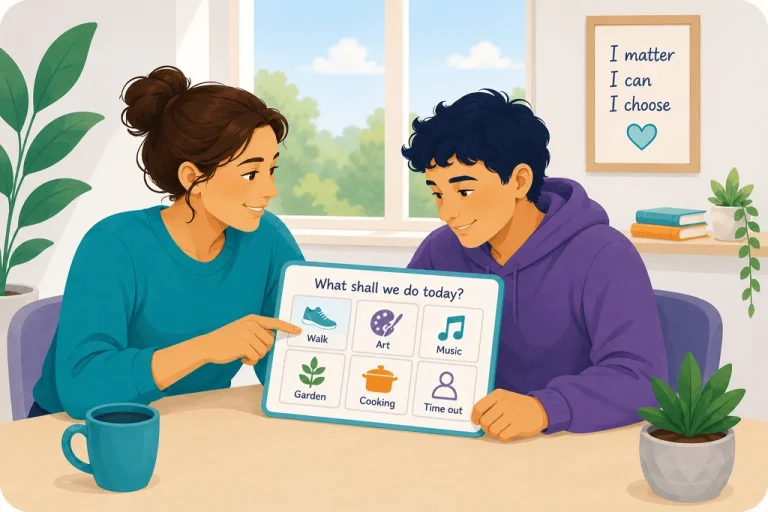


What I’ve learned most from working with autistic people, and throughout my career in supporting people with autism, is actually quite simple: ask people what they need, show up consistently, offer support, and trust them. – Louise Bray
Key Findings on Autistic Burnout in the UK
- Autistic burnout is highly prevalent – most autistic people experience it at some point
- Masking is a leading cause– especially in women and people diagnosed later in life
- Sensory overload and chronic stress make it worse
- It goes beyond exhaustion – includes loss of skills and reduced ability to manage daily life
- Often misdiagnosed – commonly mistaken for depression, anxiety, or bipolar disorder
- Real-life impact is significant – linked to low employment rates and school absence in the UK
- Recovery requires change – rest, reduced masking, and informed support
You have been feeling exhausted for months, struggling with daily tasks, and noticing a growing decline in your energy and functioning? It is not your fault, and you are not alone. You are probably going through an autistic burnout.
Around 80% of autistic people experience autistic burnout at some point in their lives, often linked to long-term masking and ongoing sensory overload.
Research shows that more than 69% of autistic adults have experienced burnout at least once, while nearly half (46%) report going through it four or more times.
What Autistic Burnout Really Is?
Autistic burnout happens when autistic needs keep being ignored, while a person continues masking and pushing past their limits again and again. In simple terms, it’s the result of living in a way that isn’t sustainable – where the environment or lifestyle is working against you, not with you. Many autistic adults who mask heavily reach a more severe level of burnout in their mid to late twenties, and for many, this becomes the point where autism is finally recognised.
Autistic burnout is a prolonged state of physical, mental, and emotional exhaustion, often alongside difficulties with thinking, communication, and everyday functioning. It is commonly linked to ongoing pressure – especially long-term masking and trying to cope with overwhelming environments or expectations.
It differs from general burnout in how deeply it affects daily life. People may experience a noticeable loss of skills, such as communication or independence in routine tasks, along with heightened sensory sensitivity. Rather than passing quickly, autistic burnout can last for months, and in some cases, even years.
While autistic burnout is often misunderstood or misdiagnosed as clinical depression, it is not the same, although it can still have a significant impact on people’s mental health.
If you ask a parent of an autistic child about the coke bottle effect, they’ll often describe a child who holds everything in at school all day, trying to cope, and then comes home where it finally all comes out in a meltdown. This can help understand autistic burnout starting from an early age.
I’ve also spent a lot of time working with parents, who often describe the challenges of masking in their children. Masking can significantly impact how needs are perceived by professionals. In more structured environments, a child may appear to cope well, but at home, where they feel safe, the full extent of their distress can emerge. This can lead to misunderstandings, underestimation of need, and ultimately a lack of appropriate support for both the child and their family. – Louise Bray
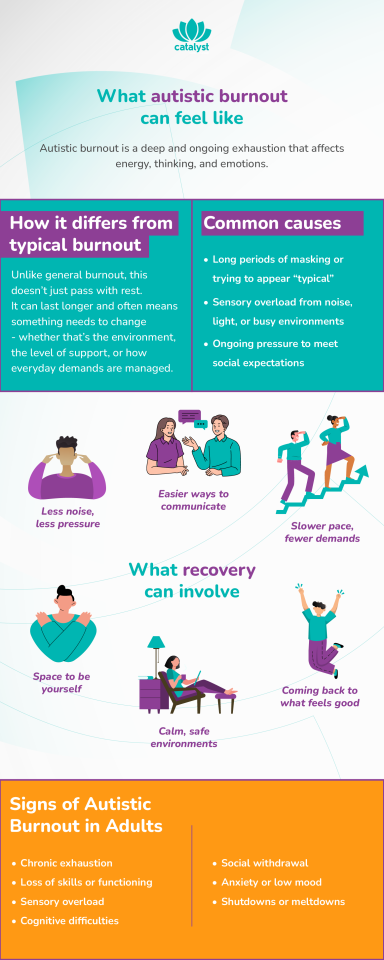
Why Burnout Happens (It’s Not Your Fault)
The lack of consistent activation of the mesolimbic reward pathway – the part of the brain linked to motivation, reward, and pleasure – means that many everyday tasks do not produce the same sense of drive or satisfaction. For many autistic people, effort does not reliably translate into a feeling of reward. Over time, this creates a quiet but persistent imbalance.
When motivation is not reinforced, everything starts to take more energy than it gives back. Tasks that require sustained attention, social interaction, or sensory regulation can feel draining without any internal “return.” This is where burnout begins to build – not from a lack of effort, but from prolonged effort without enough recovery or reward.
Over time, this can show up as:
- A sense of apathy or emotional flatness
- Lethargy and reduced physical and mental energy
- Withdrawal from people, environments, or responsibilities
- Avolition – finding it hard to initiate even basic tasks
- Loss of skills or reduced functioning in communication, organisation, or daily life
This is often intensified by:
- Masking for long periods, especially in school or work environments
- Sensory overload without adequate recovery time
- Constant adaptation to environments that are not designed with autistic needs in mind
- Pressure to meet expectations without the right support or understanding
What makes this different from general burnout is not just the exhaustion – it is the depth of the shutdown. When the system is pushed for too long without enough reward, safety, or regulation, the body and brain do not just slow down. They start to conserve energy in a more extreme way.
That is why autistic burnout is not simply “being tired.” It is what happens when effort has been sustained for too long without enough return, and the system can no longer keep compensating.
For many people in the autistic community, autistic burnout is the point at which they begin to seek support and receive a diagnosis.
What Causes Autistic Burnout?
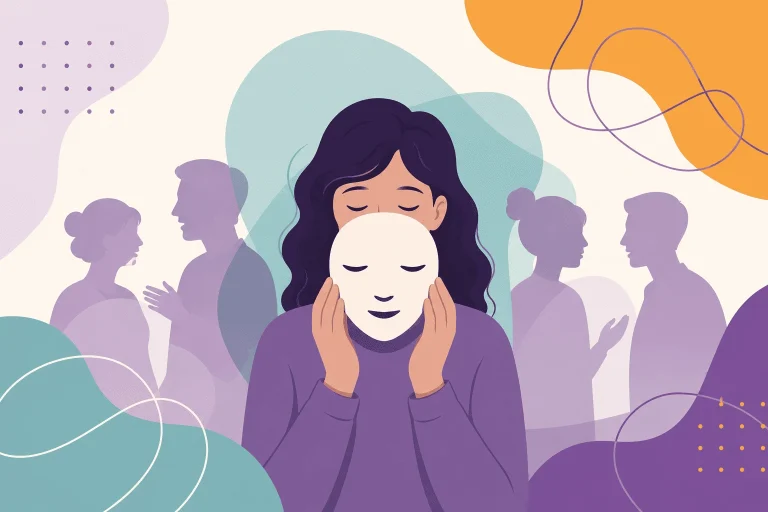
Spending years hiding how things actually feel and trying to come across as “fine” when that isn’t the case can slowly wear you down.
That whole “fake it till you make it” way of getting through things might hold for a while, but it often catches up in the end – and when it does, it can lead to a much deeper kind of burnout that doesn’t just pass.
It isn’t completely different from other types of burnout, but autistic people often experience it more intensely, and it can last far longer – sometimes for months, sometimes even years.
Autistic burnout does not usually come from one single event. It tends to build over time, when everyday life consistently asks more than a person can comfortably manage – especially without the right understanding or support in place.
- Chronic masking: Continuously trying to appear “neurotypical” – suppressing natural behaviours, forcing eye contact, monitoring speech and reactions – can become deeply exhausting. Over time, this drains mental and emotional energy, even if it is not always visible to others.
- Life transitions: Periods of change, such as puberty, starting a new job, moving home, or navigating new social expectations, can increase pressure. These moments often come with uncertainty, new routines, and higher social demands, which can quickly become overwhelming.
- Lack of support or accommodations: Being in environments that do not recognise or adjust to neurodivergent needs – such as sensory sensitivities, communication differences, or the need for routine – creates ongoing strain. Without adjustments, even simple tasks can require significantly more effort.
- Cumulative ongoing stress: Burnout often reflects a gradual build-up rather than a sudden collapse. Repeated small demands – noise, social interactions, decision-making, unpredictability – can stack up over time until coping capacity is exceeded.
- Sensory overload: Constant exposure to overwhelming sensory input (bright lights, loud environments, crowded spaces) can keep the nervous system in a heightened state, leaving little opportunity for recovery.
- Pressure to meet external expectations: Trying to keep up with work, education, or social standards that are not designed with autistic experiences in mind can lead to ongoing tension and self-doubt, especially when effort goes unnoticed.
Over time, these factors can combine, reducing energy, tolerance, and functioning. What may look like a sudden decline is often the result of a long period of holding things together without enough space to recover.
From my personal and professional experience, I’ve worked with many autistic adults, supporting them to navigate working life. Some have joined my team after long periods out of work due to autistic burnout. What has consistently stood out is how important it is to create environments where people can be authentically themselves, without the need to mask, and feel psychologically safe. – Louise Bray
The Lived Experience: How Burnout Can Feel
Many people report experiencing autistic burnout due to the constant pressure to act “typical” and meet workplace expectations. It eventually results in losing their job and, along the way, their inner self.
Many autistic people describe burnout as something very different from ordinary stress or depression – more like a deep, ongoing shutdown of both body and mind. They talk about losing skills they once had, such as speaking clearly, organising basic tasks, or keeping up with daily routines.
- “I used to be able to do this…”
Many talk about losing skills they had before – struggling to speak the same way, forgetting how to organise simple things, or not being able to keep up with everyday routines that once felt manageable. - “Even small things feel too much”
Things like replying to a message, leaving the house, or getting out of bed can start to feel overwhelming, like there’s just no energy left to push through. - “I was holding it together for too long”
A lot of people link it to years of masking – acting “okay” at school, work, or around others – until it builds up and something just gives. - “I just needed to disappear for a while”
When it hits, people describe deep exhaustion, pulling away from others, and needing space and isolation just to cope. - “It feels like I’m not fully here”
Some describe feeling empty or disconnected, while others say their brain slows down, like it’s not cooperating anymore. - “It doesn’t go away quickly”
This isn’t something that passes in a few days – many say it lasts for months, sometimes years. - “People don’t understand what this is”
A lot of experiences include being misunderstood – seen as lazy or depressed, instead of someone dealing with long-term overload.
Signs of Autistic Burnout in Adults
Autistic burnout shows up in ways that go beyond everyday stress or tiredness. It affects energy, thinking, communication, and the ability to manage daily life, often after a long period of coping with ongoing demands.
Common signs include:
- Decline in daily functioning: Tasks that were previously manageable – such as communication, self-care, or routine responsibilities – may become difficult or feel out of reach.
- Increased intensity of autistic traits: Sensory sensitivities, need for routine, or communication differences may become more pronounced.
- Reduced ability to mask: The effort required to hide autistic traits becomes too much, making masking feel impossible to maintain.
- Cognitive difficulties: Confusion, mental fog, and challenges with executive functioning, such as planning, organising, or making decisions.
- Dissociation or feeling disconnected: Some people describe feeling detached from their surroundings or themselves, especially during periods of overwhelm.
- Heightened sensory overwhelm: Lower tolerance to noise, light, touch, or busy environments, often leading to shutdowns or meltdowns.
- Increased need to withdraw: A stronger need for isolation in order to cope and recover from ongoing demands.
- Chronic exhaustion: A level of fatigue that doesn’t go away with rest or sleep – even small tasks can feel overwhelming.
- Loss of skills or reduced functioning: Things that once felt manageable – speaking, organising, self-care, or maintaining independence – may suddenly become much harder.
- Increased sensory sensitivity: Sounds, lights, textures, or crowded environments can feel more intense than usual, leading to shutdowns or meltdowns more quickly.
- Masking becomes unsustainable: Keeping up a “neurotypical” presentation starts to feel impossible, often leading to visible distress or withdrawal.
- Cognitive overload: Difficulties with focus, memory, decision-making, and executive functioning become more noticeable.
- Social withdrawal: A stronger need to step back from people and interactions in order to recover and reduce overwhelm.
- Emotional regulation difficulties: Increased irritability, low mood, or feeling emotionally drained, sometimes without a clear trigger.
- Loss of motivation: Activities that once felt enjoyable or manageable may no longer feel accessible or worth the effort.
- Longer recovery time: It takes much more time to recharge after everyday demands, social interactions, or sensory exposure.
- Increased shutdowns or “freezing”: Rather than outward distress, some people may feel stuck, unresponsive, or unable to act.
For many autistic people, these signs build gradually rather than appearing all at once, often following long periods of masking, sensory strain, and unmet support needs.
Skills don’t disappear during burnout, there isn’t enough mental and physical energy to access them.
How Long Does Autistic Burnout Last?
Autistic burnout usually lasts for months, and in some cases, even years. Shorter periods of a few days or weeks can happen, but they’re less common.
Recovery takes time and happens in phases. It depends on reducing pressure and having the right support in place, with energy slowly coming back and day-to-day functioning gradually improving.
Burnout can last for years, especially when someone keeps trying to push through it. It can lead to a loss of skills, although that’s not quite the right way to describe it. It’s more like the energy and capacity just aren’t there anymore. It can leave someone feeling like a shadow of who they used to be – wanting to do things, but being too exhausted to follow through. From the outside, it can look like depression or lethargy, but it’s really a deep, ongoing exhaustion. Even things that once felt enjoyable or grounding can become too much. Everyday functioning starts to slip, things get missed, and it can feel like everything is slowly unravelling. Once it reaches that point, it can be very hard to come back from, even with support. This isn’t about scaring anyone. It’s about recognising how important it is to live in a way that actually supports you. Knowing personal limits, setting boundaries, and taking care of yourself can make a real difference. – Adapted from a real lived experience to protect privacy and personal identity.
Common factors that influence how long burnout lasts
- Ongoing stress: Being constantly exposed to overwhelming environments – like noise or high social demands – can keep burnout going for longer.
- Masking: Continually hiding autistic traits adds to the strain. When masking is reduced, recovery tends to happen more easily.
- Support: Having understanding, neuro-affirming support and the right environment can help shorten the recovery period.
Practical First Steps Toward Recovery
Autistic burnout is a clear indicator that something in life is no longer working as it should and needs to change.
In most cases, it isn’t caused by just one factor, but by a build-up of ongoing demands, expectations, and environments that have become overwhelming over time.
So where do you begin?
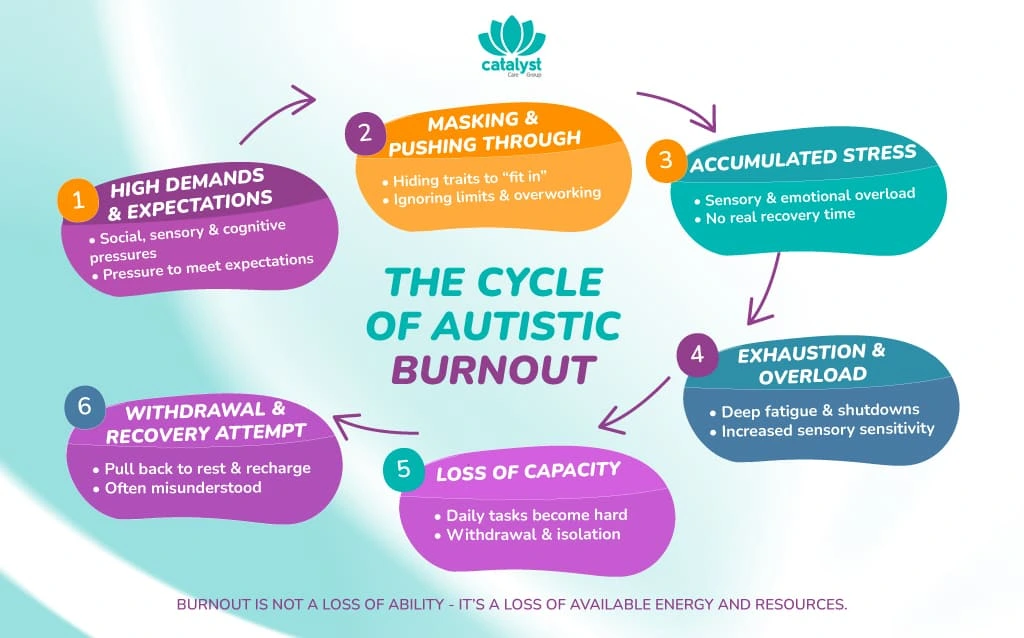
It starts with understanding where you are in the cycle of autistic burnout.
The Cycle of Autistic Burnout
1. Warning Phase
- Energy starts to dip
- Increased overwhelm, irritability, or anxiety
- Everyday tasks begin to feel harder than usual
What’s happening:
Early signs that demands are starting to exceed capacity.
2. Acute Burnout
- Sudden drop in energy and functioning
- Difficulty managing even basic daily tasks
- Increased shutdowns, meltdowns, or withdrawal
What’s happening:
The system is overwhelmed – the body and mind can’t keep up anymore.
3. Chronic Burnout
- Ongoing, long-term exhaustion
- Reduced functioning or loss of skills
- Very low tolerance for sensory, social, or cognitive demands
What’s happening:
Burnout becomes prolonged when stressors continue and recovery hasn’t been possible.
Support That Actually Helps
Support during autistic burnout is not about doing more, pushing harder, or “building resilience.” It’s about reducing what is overwhelming and making everyday life feel manageable again.
What this support can look like:
- Reducing autistic masking demands
Creating environments where there is no pressure to act “typical,” perform socially, or hide natural behaviours. - Making space for special interests
Allowing time and freedom to engage in interests that feel safe, regulating, and familiar. - Adapting noisy environments
Minimising sensory overload through quieter spaces, predictable routines, and fewer competing demands. - Lowering expectations and demands
Adjusting workloads, social expectations, and daily responsibilities to match current capacity. - Supporting the recovery process
Prioritising rest, consistency, and gradual re-engagement without pressure to “bounce back.”
In practice, it means being flexible and responsive to individual needs. If someone needs a break in the middle of the day, that’s absolutely fine. If they need to step out of a meeting, no problem. If fixed 9–5 hours don’t work for them, flexibility makes all the difference. When people are trusted, supported, and given autonomy, they thrive, and they do an exceptional job. – Louise Bray
How Loved Ones Can Help?
When someone is in autistic burnout, support is less about what you say and more about what you change around them. It often means stepping out of the usual patterns and adjusting how everyday life works.
What this can look like in real life:
- Change the pace of the household
Slow things down. Fewer plans, fewer last-minute changes, less rushing. Keep days predictable. - Remove “hidden” pressures
Things like:
“We’re all going, it’ll be quick”
“Just try for a bit”
These still create pressure. Replace them with genuine choice – and accept the answer. - Take initiative without making it a big deal
Instead of asking “Do you need help?” (which requires energy to answer), just do small things – make food, handle a task, reduce the decisions they need to make. - Normalise doing less
Don’t highlight it, question it, or compare it to before. The less attention on “not functioning,” the safer it feels. - Hold boundaries with others for them
Cancel plans, explain to relatives, limit visits. Don’t make the person in burnout manage other people’s expectations. - Notice energy patterns
Pay attention to when they seem slightly better or worse, and adjust around that – not the other way around. - Keep connection low-effort
Sit in the same room, watch something quietly, share space without needing interaction. - Avoid turning recovery into a “plan”
No schedules, no targets, no “steps to get better.” Recovery is not something to optimise. - Be careful with reassurance
Even positive pressure like “you’ll be back to yourself soon” can feel heavy. Stay present instead of future-focused.
You Deserve a Life That Fits You
You deserve a life that actually works for you. Not one where you’re constantly tired from trying to keep up. When things start feeling harder than before, that usually means you’ve been pushing for too long without enough space to breathe.
At some point, it makes more sense to stop forcing everything. Do less for a bit. Spend time with people where you can just be yourself. Go back to things that feel easy and natural – your creativity, the things you enjoy, the things you’re good at. The things that make you feel like yourself again, not drained.
And if it starts affecting your health or your day-to-day life, it’s okay to get proper support. It can help you get back on track before things get worse.
If you’re dealing with extreme fatigue, it can start to affect how you show up at work and how you use your strengths. Things that usually come naturally – focus, creativity, problem-solving, communication – can feel harder to access, simply because your energy is low.
With the right support and enough space to recover, those strengths come back into reach.
Catalyst Care Group Supports People with Autism
At Catalyst Care Group, we believe that with the right support, autistic people – whether children, young people, or adults – can live in a way that works for them. Our Autism Accredited approach is grounded in community-based, person-centred support, shaped around each person’s strengths, needs, and communication style. Families often share that they are looking for support that reduces distress, helps their loved one feel understood, and makes everyday life easier to manage and more predictable. This is exactly where our focus is.
Our support includes:
- Specialist digital communication tools that help people express needs, emotions, preferences, and aspirations, while also making it easier to communicate when something feels wrong, overwhelming, or painful.
- Occupational Therapy that supports sensory needs, emotional regulation, and daily living skills in ways that reduce pressure and make everyday tasks more manageable.
- Positive Behaviour Support (PBS) that looks beyond behaviour, focusing on what a person is communicating and reducing distress through supportive routines and environments.
- Multimedia support that presents information in clear, accessible formats, helping people understand, communicate, and take part with more confidence.
- Community-based support that builds independence, supports confidence, and helps create meaningful routines within familiar environments.
- Specialist support delivered at home, in school, or in the community.
For families needing more structured, professional support with managing autistic burnout, Catalyst Care Group provides tailored, personalised support that helps people regain and strengthen their skills, develop new ones, and manage daily life in a way that works for them.
To learn more about how our Autism Accredited teams can support families – and how our therapists, tools, and specialists can help people feel understood and more able to navigate everyday life – support is available through Catalyst Care Group’s autism support services.