Families turn to health and social care services when someone they love needs support. They expect timely access to appropriate care that meets their current needs. But for many families, seeking support becomes a source of trauma.
Repeated hospital admissions. Restrictive practices. Long periods of uncertainty. Having to ask for the same support again and again. Feeling excluded from decisions, blamed when things go wrong, or unheard when raising concerns. Over time, these experiences can leave their mark on the whole family.
By the time a family meets a new care provider, they may already have years of difficult experiences behind them. Kate Mercer from Blackbelt Advocacy describes this as an “invisible suitcase” – one that may carry fear, anger, grief, guilt, shame and a deep loss of trust in services.
Before seeing a family as angry, demanding or difficult, understand what may have happened before they reached the service.
What Is Family Trauma in Health and Social Care?
Family trauma is the emotional and psychological impact that a distressing or traumatic experience can have across a family, affecting how people feel, respond, relate to one another and experience the world around them. It can follow one significant event, but it can also build through repeated experiences of fear, uncertainty, loss of control or feeling powerless to protect someone you love.
Family trauma usually involves cumulative, repeated negative experiences rather than a single traumatic event.
Within health and social care, that trauma can sometimes be connected to the experience of seeking support itself. Imagine watching someone you love go through repeated hospital admissions, restraint or seclusion. Having to fight for the right support. Sitting in meetings where you feel your knowledge of them carries little weight. Raising concerns and feeling unheard. Or being questioned and blamed at a time when your family is already struggling.
When experiences like these happen repeatedly, their impact can reach far beyond an individual interaction with a service. This is increasingly recognised through the concept of systems-generated trauma – harm caused or intensified through people’s interactions with the systems they depend on for support.
Trauma can leave lasting effects on you and the people you love. But healing is possible. Learn how to recognise trauma, understand its impact and find ways to heal. You are not alone.
In 2025, Cerebra published research involving more than 1,200 parents of disabled children. Family members described effects on their physical and mental health, finances, relationships, children’s education and, significantly, their trust in public services.
How Can Health and Social Care Experiences Lead to Family Trauma?
A traumatic experience can affect an entire family. Parents, siblings and partners may share the fear, uncertainty and emotional impact of what has happened, even when they have not experienced the trauma directly themselves.
Research involving more than 4,000 parents found that around 1 in 6 developed post-traumatic stress disorder (PTSD) following a traumatic experience involving their child. Families may also experience the same traumatic event together, including physical abuse, violence or other distressing experiences.
The effects can continue long afterwards, influencing emotional wellbeing, family relationships and how people respond to future situations. For families receiving health and social care support, experiences within the care system can become part of this too. Hospital admissions, restraint and restrictive practices, difficulties accessing support, exclusion from decisions, or repeated experiences of feeling blamed or unheard can create further distress for a family already under significant pressure.
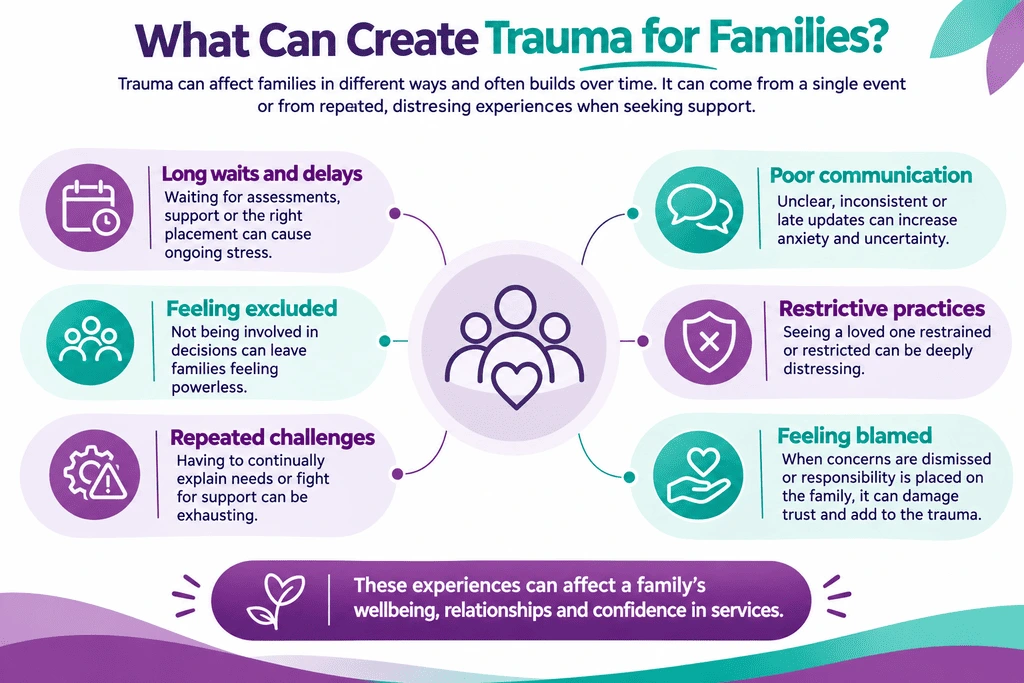
Fighting to Access the Right Support
Getting the right support can become a long and exhausting process for families. What begins as a request for help can turn into months or even years of appointments, assessments, phone calls and conversations with different services.
Families may find themselves:
- asking for the same support repeatedly, even when needs have already been identified
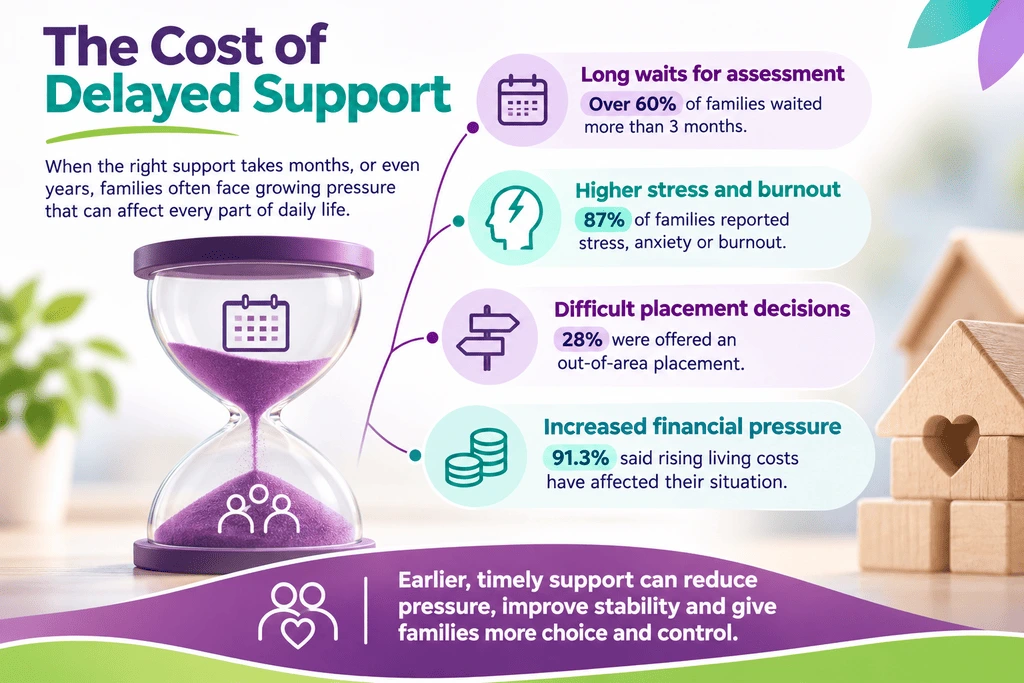
- waiting through long delays for assessments, decisions or appropriate services
- going through repeated assessments and explaining the same circumstances to different professionals
- dealing with fragmented services, where health, social care and other teams do not communicate effectively
- chasing referrals, updates and decisions because it is unclear who is responsible
- raising concerns without feeling heard or taken seriously
- receiving decisions without a clear explanation of how or why they were made
- constantly advocating for their loved one to access the support they need
Recent UK research into systems-generated trauma has identified many of these experiences, including bureaucracy, repeated assessments, poor communication between services and families feeling unheard.
When families have to keep asking, explaining, chasing and challenging simply to access support, the process itself can become another source of distress.
Hospital Admissions, Restraint and Restrictive Practices
A hospital admission can affect the whole family system. Family members and other relatives may be living with uncertainty about how long someone will remain in hospital, whether they are safe, what is happening when the family is not there, and when, or whether, they will be able to return home.
The impact can become greater when families experience:
- repeated hospital admissions, with periods of stability followed by another crisis or admission
- detention and long periods away from home, affecting everyday family life and relationships
- restraint, seclusion or other restrictive practices, particularly when a family witnesses them or learns about them afterwards
- distressing incidents in hospital, leaving families worried about the person’s physical and emotional wellbeing
- limited involvement or information, making it harder for families to understand what is happening and why
- fear for the person’s safety, particularly when previous experiences have already damaged trust
- repeated admission and discharge cycles, requiring families to continually adjust to someone leaving and returning home
This often involves families reaching services after years of hospital detention, long-term seclusion, repeated admissions and restrictive practices. Experiences like these can impact relationships, family roles, routines and the sense of safety within the family, with the effects continuing after the person has left hospital.
Parent Carer Blame and Exclusion From Care Decisions
Families often know the person in ways an assessment or care plan cannot capture. They notice small changes, understand how the person communicates and can often recognise when something is wrong long before it becomes obvious to others. Professionals bring their own knowledge and expertise, but difficulties can arise when they treat the family’s knowledge as less important.
This can gradually change the way families experience care. A parent raising a concern may feel dismissed. Questions can be interpreted as criticism. Disagreement with a decision can lead to judgement or blame. When this happens repeatedly, families may begin to feel that being involved means continually proving their knowledge matters.
This may include:
- being blamed when something goes wrong, including situations where concerns had already been raised
- feeling judged for questioning or disagreeing with decisions
- having important knowledge about the person overlooked or dismissed
- raising concerns without feeling listened to
- being excluded from discussions about care and support
- feeling that professional opinion is automatically given greater weight
- becoming reluctant to seek support again because previous experiences have left them expecting the same response
What Are the Signs of Family Trauma?
Trauma can show up in ways that are easy to misunderstand. Fear may look like a constant need for reassurance. Distrust may come through as questioning decisions. A parent who has seen their child or loved one harmed or distressed may become highly protective. Anger and frustration may surface after months or years of feeling that concerns have not been heard.
Possible signs and responses may include:
- Anger and frustration – particularly when families feel they have repeatedly had to fight to be heard or taken seriously.
- Anxiety and fear – worrying about someone’s safety, what might happen next or whether previous experiences could happen again.
- Distrust of professionals and services – finding it difficult to build confidence in a new team after trust has previously been broken.
- Heightened protectiveness – closely monitoring someone’s care or finding it difficult to step back after witnessing them experience distress or harm.
- Repeatedly questioning decisions – wanting to understand why decisions are being made and challenging them when something does not feel right.
- Expecting something to go wrong – remaining alert to possible problems, even when the person is now receiving different support.
- Needing more information and communication – seeking regular updates and greater involvement in what is happening.
- Difficulty accepting reassurance – words alone may carry little weight when previous promises or reassurances have not matched a family’s experience.
Why Families Experiencing Trauma May Be Labelled “Difficult”
Families who ask repeated questions, challenge decisions or focus closely on particular aspects of care can sometimes be labelled as “difficult”. But what looks like demanding behaviour may come from previous experiences where things went wrong, concerns were missed, or trust was broken.
This can be particularly visible in the small details. A parent may repeatedly ask whether teeth have been brushed, check that their family member is wearing their own clothes, notice dirty socks or become upset about unchanged bedsheets. To someone else, these may seem like relatively minor concerns. To the family, they can be important signs of whether the person is receiving the attention and care they need.
One small thing that tells them something much bigger about what may be happening when they are not there.
When professionals feel challenged, criticised or uncomfortable, there is a risk of focusing on the family’s behaviour instead of the reason behind it. Questions become “complaints”. Persistence becomes “difficult behaviour”. A worried parent becomes a “difficult parent”.
That is how parent-carer blame can take hold, and why the label itself can prevent professionals from understanding the very concerns the family is trying to communicate.
How Can Family Trauma Affect Trust in Care Services?
A new care team may be starting a relationship with a family for the first time. The family, however, may not be starting from the same place.
Experiences of psychological trauma, emotional neglect, physical distress or complex trauma can affect a person’s sense of safety and their ability to trust others. When difficult experiences have also involved care services, that uncertainty can extend to the professionals and organisations involved in future support.
This means trust cannot be expected simply because a new service is involved. It develops when families see, over time, that concerns are acted on, information is shared openly, commitments are kept, and mistakes are acknowledged.
UK research into Systems Generated Trauma has identified loss of trust in public services as one of its wider effects. This is also reflected in UK trauma-informed practice guidance, which recognises the importance of safety, trust and relationships when supporting people affected by trauma.
For care providers, the starting point is not asking families to trust again. It is giving them reasons to
What Does Trauma-Informed Support for Families Look Like?
Trauma-informed support considers the family as well as the person receiving care. Family members may have their own experiences of childhood wounds, domestic violence or relational trauma, while others may be coping with experiences that have affected the family over time. This can influence family dynamics, relationships, coping strategies and the family environment.
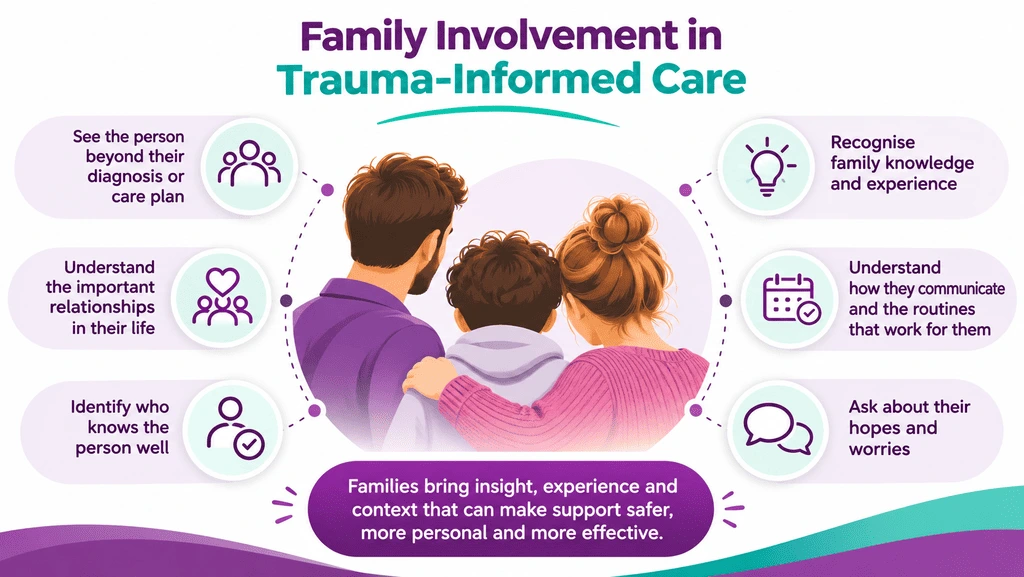
Where appropriate, a trauma-informed assessment can explore what family members have experienced, how they are coping and what support may be useful alongside the care provided to the individual. Depending on the family’s circumstances, this may include individual or family therapy, psychological support or practical strategies for coping and managing difficult situations.
In everyday practice, trauma-informed support can mean:
- Creating emotional and physical safety
- Listening before trying to fix
- Listening without having to agree
- Recognising previous experiences of trauma
- Building trust through honesty and consistency
- Offering meaningful choice and involvement
- Working collaboratively with families
- Explaining decisions clearly
- Acknowledging mistakes
- Avoiding re-traumatisation
- Understanding families’ hopes and worries
- Supporting choice, voice and empowerment
At its core, trauma-informed practice means taking time to understand before responding. It means resisting the immediate urge to defend a decision, justify what happened or find a quick solution, and making space to hear what the family is actually trying to communicate.
How Can Care Providers Build Better Relationships With Families?
There will be times when families and professionals see things differently. A parent may question a decision. A professional may have concerns the family does not share. These moments do not have to create an “us versus them” relationship. There can still be respect, honest conversation and a willingness to understand where the other person is coming from.
That means:
- listening with genuine interest
- getting to know the family, not just contacting them when something goes wrong
- valuing what families know alongside professional expertise
- doing what was agreed and being honest when plans change
- talking through disagreements instead of becoming defensive
- saying when something has gone wrong
- taking the time to rebuild a relationship when trust has been damaged
For families who have experienced trauma, even a conversation can bring back difficult or traumatic memories. Sometimes, families simply need someone who will listen and try to understand their concerns before offering explanations or solutions.
Catalyst Care Group Supports Families Experiencing Trauma
At Catalyst Care Group, we work closely with people and families who had been through trauma. Together with our teams, we developed individualised training so that the family and the person supported can co-produce a trauma-informed care plan. We take time to listen and get to know each family at people’s own pace.
Good care is founded on trust and respectful relationships. We listen, we learn, we care.
For more information on how we can support you, contact us today.
FAQs
What is Systems-Generated Trauma?
Systems-generated trauma describes the harm that can occur when people and families repeatedly experience difficulties within the services they depend on. This can include long delays, repeated assessments, poor communication, exclusion from decisions, having to continually fight for support or feeling blamed and unheard. Over time, these experiences can affect wellbeing and trust in services.
Can Restraint and Restrictive Practices Cause Trauma for Families?
Yes. Seeing a family member restrained, secluded or subjected to other restrictive practices can be deeply distressing. Even when relatives are not present, hearing what happened afterwards or worrying that it may happen again can leave families feeling frightened, powerless or constantly concerned about the person’s safety.
What is Parent Carer Blame?
Parent carer blame happens when responsibility for difficulties surrounding a child or family member is placed on the parent or carer without properly considering the wider circumstances. Concerns may be dismissed, parenting questioned, or a parent described as “difficult” when they challenge decisions or continue asking for support.
How Can Health and Social Care Services Avoid Re-Traumatising Families?
Services can reduce the risk of re-traumatisation by listening carefully, communicating openly, involving families in decisions and recognising experiences that may have affected their trust. Giving clear explanations, offering choice where possible, keeping commitments and acknowledging mistakes can all make interactions feel safer and more respectful.