
The Deprivation of Liberty Safeguards (DoLS), set out in the Mental Capacity Act 2005, exist to make sure a person is not being restricted in an unfair or unlawful way, especially in care homes and hospitals. A deprivation of liberty happens when someone is under continuous supervision and control, is not free to leave, and cannot consent to the arrangements because they lack capacity. These safeguards come from Article 5 of the European Convention on Human Rights, which means any restriction must be lawful, necessary, and proportionate.
Preventing a person from leaving a care home without staff supervision may amount to an unlawful restriction of liberty where the person has the mental capacity to make that decision. This can engage rights under Article 5 of the European Convention on Human Rights (liberty) and Article 8 of the European Convention on Human Rights (private and family life) and may be subject to legal challenge.
Background and Purpose of DoLS
The Deprivation of Liberty Safeguards (DoLS)provides a legal framework for situations where care arrangements restrict a person’s freedom – for example, not being able to leave a setting alone or being under continuous supervision.
In real life, this often looks like:
- A person in a care home who tries to leave but is brought back for safety reasons
- Someone with mental health needs who is closely monitored to prevent harm, but has limited choice about going out
- A person in hospital who cannot discharge themselves, even if they express a wish to go home
DoLS is used to check and authorise these situations, making sure there is a clear reason, proper assessment, and ongoing review.
Best interests decisions are meant to reflect the person’s life, not just their risks.
For example:
- Instead of stopping someone from going out, support can be adjusted so they go out safely with the right support
- Instead of fixed routines, the day is shaped around what the person prefers and enjoys
The Deprivation of Liberty Safeguards (DoLS), under the Mental Capacity Act 2005, exist to protect something very simple but often overlooked in practice – a person’s freedom, dignity, and right to make choices about their own life.
When someone cannot make certain decisions for themselves, support can sometimes become more controlling than intended. DoLS makes sure this never happens quietly or without question.
It asks: Is this the least restrictive way to support this person? Are we truly listening to what matters to them?
Benefits and Downfalls of DoLS
In practice, DoLS may not always feel like protection.
- It can become restrictive in itself, especially when used routinely
- Decisions are sometimes made for the person, not with them
- Delays mean people can be under restrictions without timely review
At the same time, without any safeguards, restrictions could happen without oversight at all.
Due to several gaps in the DoLS system, identified through a national review by the Law Commission, the UK Government introduced the Liberty Protection Safeguards (LPS) through the Mental Capacity (Amendment) Act 2019 to ensure people are properly protected when their freedom is restricted, across all care settings, with a stronger focus on their rights, dignity, and choices.
Who DoLS Applies to?
Deprivation of Liberty Safeguards (DoLS) apply when a person lacks capacity and specific conditions are met, including:
1. Age
- Applies to people aged 18 and over.
2.Lack of Capacity
Under the Mental Capacity Act 2005, a person must:
Not be able to understand, retain, weigh, or communicate decisions about:
- their care
- where they live
Capacity is decision-specific and time-specific.
Someone might have capacity in some areas, but not in others.
3. The “Acid Test”
From the Cheshire West case, a person is considered deprived of liberty if:
- They are under continuous supervision and control
- They are not free to leave
This applies regardless of:
- whether the setting is comfortable
- whether the person seems content
- whether the restrictions are “for their own good”
4. The Setting (this is often missed)
DoLS only applies in:
- Care homes
- Hospitals
If the same situation happens:
- in supported living
- in a person’s own home
It cannot be authorised under DoLS
It goes to the Court of Protection instead
5. Why DoLS Exists
DoLS is there to ensure restrictions are:
- Lawful
- Necessary
- Proportionate
- There is independent oversight
This links directly to Article 5 European Convention on Human Rights – the right to liberty.
What this looks like in real life
A person with dementia in a care home:
- Staff decide when they eat, sleep, go out
- Doors are locked
- If they try to leave, they are brought backA person in hospital:
- Not allowed to leave the ward
- Under constant monitoring
- Cannot consent to treatment or placementA person with a learning disability:
- Needs 1:1 supervision
- Cannot go out alone
- Decisions made by carers
In all these cases, even if care is good, liberty is still being restricted – so legal safeguards must be in place.
What Does “Lacking Capacity” Really Mean?
In law, “lacking capacity” comes from the Mental Capacity Act 2005. It has a very specific meaning, and it’s often misunderstood.
It does not mean a person lacks capacity overall, and it does not attach to a diagnosis. It is always about a particular decision, at a particular time.
Capacity Is Decision-Specific
A person may be able to make some decisions but not others.
For example:
- Someone may decide what they want to eat or wear
- But struggle to understand a complex financial agreement
- Or feel overwhelmed when deciding where to live or what treatment to accept
Capacity is not “all or nothing.” It shifts depending on:
- how complex the decision is
- how it is explained
- the person’s emotional state in that moment
Capacity can change over time
Capacity is also time-specific.
A person might:
- understand information in the morning but not later in the day
- regain clarity after treatment or support
- lose capacity temporarily during distress, pain, or crisis
This is why assessments should never be treated as permanent labels.
What does the law actually look for?
Under the Mental Capacity Act 2005, a person is considered to lack capacity for a specific decision if they cannot do one or more of the following:
- Understand the information relevant to the decision
- Retain that information long enough to make the decision
- Use or weigh that information as part of the process
- Communicate their decision (in any form – speech, signs, behaviour)
If any one of these is not possible, capacity may not be present for that decision at that time.
It’s not about making “wise” decisions
A person is not seen as lacking capacity just because they make a decision others disagree with.
This is a core principle of the Mental Capacity Act 2005:
People have the right to make decisions that others may see as unwise.
What matters is how the decision is made, not whether others think it’s the “right” one.
Why this matters in practice
In real settings, this changes how support is approached.
Instead of asking:
- “Does this person have capacity?”
The question becomes:
- “Do they have capacity to make this decision, right now, with the right support?”
And importantly:
- Have all steps been taken to support them to decide for themselves first?
This could include:
- breaking information into simpler parts
- using visual or multimedia tools
- giving time, not rushing decisions
- involving people they trust
A grounded way to think about it
Lacking capacity is not a label.
It’s a temporary and decision-bound difficulty in processing information.
People move in and out of capacity depending on:
- context
- communication
- environment
- emotional and physical state
When this is understood properly, the focus shifts:
- from control → to support
- from assumptions → to assessment
- from restriction → to enabling choice wherever possible
What is Article 5 of the European Convention on Human Rights?
Article 5 of the European Convention on Human Rights sets out a person’s right to liberty and security. It makes clear that no one can be deprived of their liberty unless it is done in a lawful way and for a specific, justified reason. These reasons include situations such as detention following a criminal conviction, or where a person needs to be kept safe due to mental disorder, but even in these cases, there must be a clear legal process. It also gives people the right to challenge their detention and to have it reviewed by a court.
In health and social care, Article 5 becomes relevant when a person is under continuous supervision and is not free to leave, especially if they cannot consent to those arrangements. In these situations, the law requires proper authorisation to make sure the restriction is justified and that the person’s rights are protected. This is where the Mental Capacity Act 2005 and the Deprivation of Liberty Safeguards (DoLS) apply.
The local authority is responsible for overseeing and authorising these situations in care homes and hospitals. It arranges independent assessments to check whether the person lacks capacity, whether the restrictions are necessary to prevent harm, and whether there is a less restrictive way to provide care. This ensures that decisions are not made by one service alone, but are reviewed through a legal safeguard.
A liberty authorisation, often called a standard authorisation, is the formal legal permission for a deprivation of liberty to take place. It confirms that the situation meets the legal criteria and that the person’s rights under Article 5 are being respected. Without this authorisation, keeping someone under continuous supervision and not allowing them to leave could be unlawful.
In urgent situations, where care needs to be put in place immediately, an urgent authorisation can be used by the care home or hospital. This allows the deprivation of liberty to begin lawfully for a short period, usually up to seven days, while the local authority completes the full assessment process. It is a temporary measure that ensures the person is protected without delay, while still moving towards proper legal authorisation.
In practice, once a person is not free to leave and is being closely supervised, Article 5 is engaged. At that point, it is no longer just a care decision. It becomes a legal responsibility to ensure that any restriction of liberty is properly authorised, necessary, and proportionate.
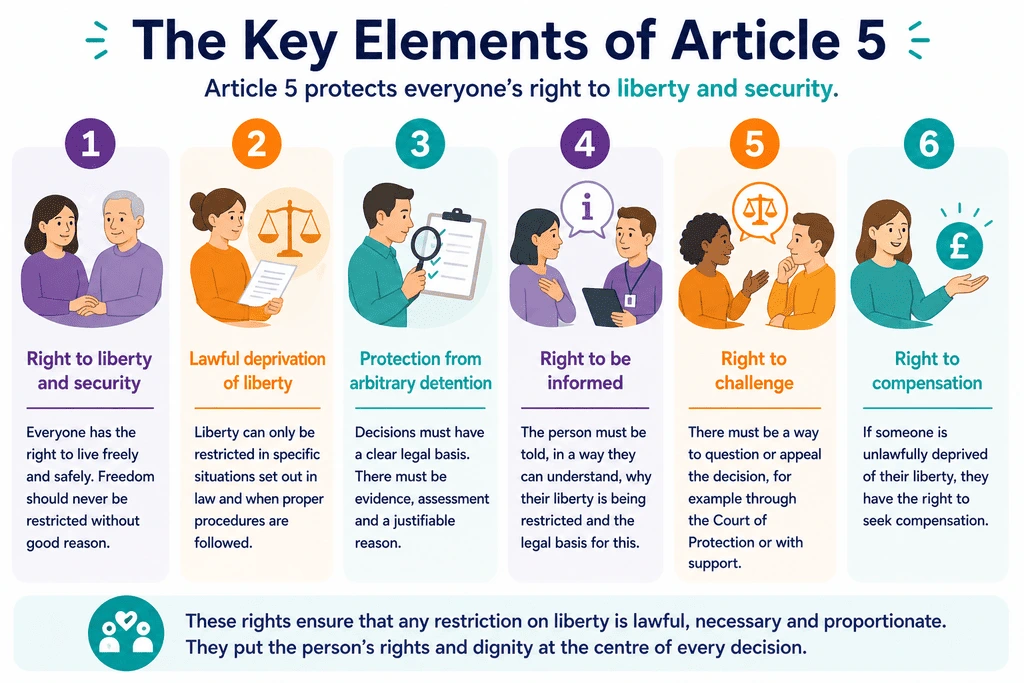
The Key Elements of Article 5
Article 5 focuses on one of the most basic human rights: liberty. It recognises that no one should be deprived of their freedom without a clear, lawful reason, and that any restriction must follow a strict legal process. In health and social care, this becomes especially relevant when someone lacks capacity and decisions are made on their behalf. The aim is not to prevent care or support, but to make sure that any restriction is justified, proportionate, and properly reviewed.
- Right to liberty and security
Everyone has the right to live freely and safely. This means freedom should never be restricted casually or for convenience, even in care settings. - Lawful deprivation of liberty
A person can only be deprived of their liberty in specific situations set out in law (for example, in cases involving mental health or lack of capacity), and only when proper procedures are followed. - Protection from arbitrary detention
Decisions cannot be made without a clear legal basis. There must always be evidence, assessment, and a reason that can be explained and justified. - Right to be informed
A person must be told, in a way they can understand, why their liberty is being restricted. This includes explaining the legal basis and what it means for them. - Right to challenge
There must be a way to question or appeal the decision. In the UK, this is often done through the Court of Protection or with the support of a representative. - Right to compensation
If someone is unlawfully deprived of their liberty, they have the right to seek compensation. This reinforces accountability in decision-making.
Each of these elements works together to ensure that when liberty is restricted, it is done carefully, transparently, and with the person’s rights at the centre.
What is the Difference Between Restriction and Deprivation of Liberty?
Restriction limits freedom while deprivation takes freedom away completely.
A restriction limits someone’s freedom in a specific, proportionate way to keep them safe.
Examples include supervision outdoors or a locked door to prevent harm.
The person still has some choice and control.
A deprivation of liberty is when those limits become continuous and complete.
Using the acid test from Cheshire West case:
- Continuous supervision and control
- Not free to leave
- Lacks capacity to consent
At this point, the situation must be authorised under the Mental Capacity Act 2005 (e.g. Deprivation of Liberty Safeguards).
How DoLS Protect Human Rights in Practice?
In practice, DoLS should protect human rights by forcing professionals to justify restrictions, carry out independent assessments, review arrangements regularly, and give people and families a way to challenge decisions.
In reality, teams often apply DoLS as a process rather than a safeguard. Professionals delay assessments, rely on paperwork instead of real scrutiny, and accept restrictive routines as normal care. They do not always involve families meaningfully, and they often overlook the person’s voice.
As a result, DoLS can legitimise existing restrictions instead of actively protecting freedom, unless teams question what they are doing and actively look for less restrictive ways to support the person.
Will DoLS be Replaced by Liberty Protection Safeguards?
Yes – DoLS are planned to be replaced by the Liberty Protection Safeguards (LPS), but the change has been delayed and DoLS still apply for now. In simple terms, LPS will do the same job (authorising situations where someone is not free to leave) but across more settings, including supported living and a person’s own home, not just care homes and hospitals.
The framework also changes who signs off decisions, with more responsibility placed on local authorities or NHS bodies, aiming to reduce delays and make the process more consistent.
The Right to Challenge a Deprivation of Liberty
If irregularities are noticed or the person feels harmed, the deprivation of liberty can be challenged immediately. The person, their family, or someone supporting them can request a review or take the case to court to question whether the restrictions remain necessary, proportionate, and lawful. This creates a clear route to stop or change arrangements that are unsafe, inappropriate, or not in the person’s best interests.
Balancing Safety and Freedom
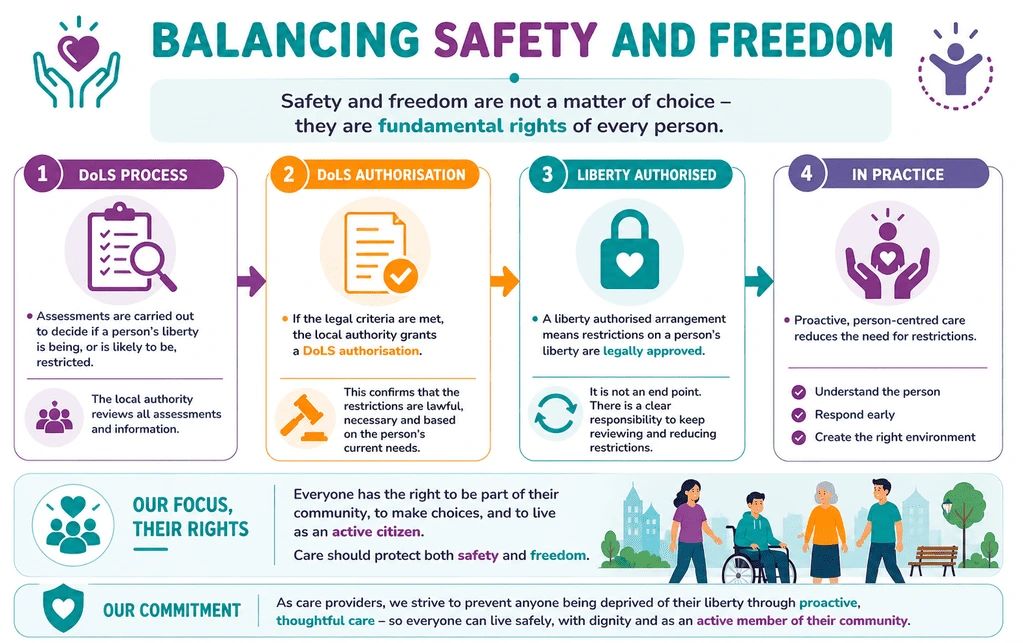
Safety and freedom are not a matter of choice – but fundamental human rights. The DoLS process ensures that if restrictions are placed on a person, they are properly assessed and legally authorised by the local authority. A DoLS authorisation confirms that the situation meets the required threshold and is based on the person’s needs.
A liberty authorised arrangement does not mean restrictions should remain in place without question. It creates a responsibility to keep reviewing and reducing them. In practice, the focus is on proactive care — supporting people early and in the right way, so they can remain active members of their community and live with as much freedom as possible.
At Catalyst Care Group, the focus is on making sure the right care is in place so that deprivation of liberty is not needed. In moments of vulnerability, what matters most is feeling safe, respected, and in control – not being placed under restrictions that can further impact emotional and physical well-being.
If you know someone who is deprived of their liberty, needs community support, is preparing for hospital discharge, or is being placed out of their local area, contact us today to discuss how we can help.